


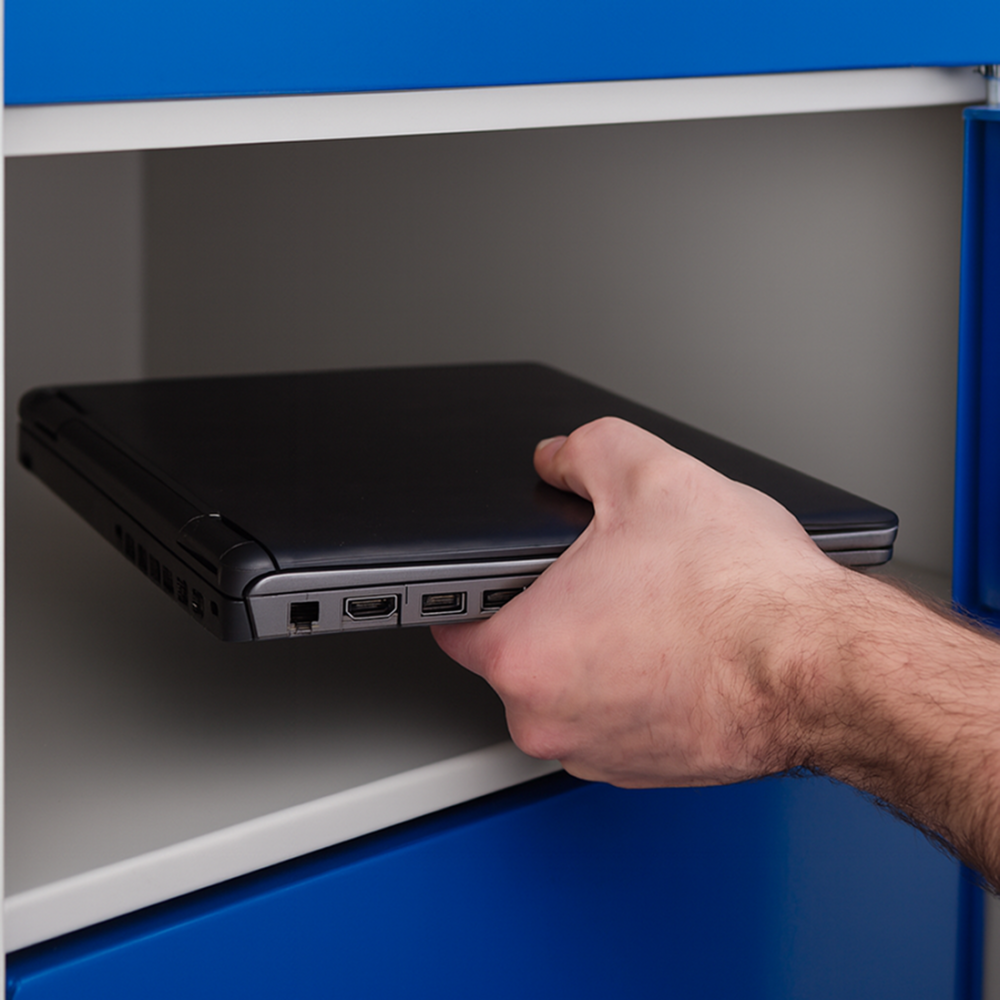
There is a point in many IT support processes where the technology stops being the problem. The ticket has been raised. The fault has been diagnosed. A replacement laptop is ready. The service desk knows exactly what needs to happen next.
And yet the employee still cannot work. They are waiting for the physical handover.
That distinction matters because employees do not judge IT support by where the delay occurred. They judge it by how quickly they can get working again. A service desk can resolve a technical issue quickly and still appear slow if somebody has to travel across an office, arrange a collection time, wait for a colleague to be available or move a device between sites.
For Heads of IT and IT Service Delivery, this creates a frustrating problem. What looks like poor IT responsiveness may actually be a logistics problem sitting at the end of an otherwise effective support process.
The clearest signs are not simply a growing ticket queue. They are employees waiting after their issue has effectively been solved, engineers being interrupted for routine collections, handovers depending on specific people or locations, unnecessary site travel, weak visibility over equipment movements and routine device logistics consuming capacity that should be used elsewhere.
When those problems appear together, device handover has stopped being an administrative task. It has become an IT service bottleneck.

The support ticket can be resolved while the employee is still unable to work. That gap is where device handover becomes an IT service problem.
The gap between resolving a ticket and restoring productivity
Most IT teams have invested heavily in the digital side of service delivery. Requests enter an ITSM platform. Devices are recorded in asset-management systems. Endpoint tools manage configuration and policies. Engineers can diagnose many problems remotely.
But eventually, the physical device has to move. Someone has to prepare it, get it to the right employee, collect the old equipment and make sure the transaction is recorded.
That part of the process is easy to overlook. It becomes more difficult in multi-site and hybrid organisations, where the employee, the equipment and the IT team may all be in different places.
Office for National Statistics research found that 28% of working adults in Great Britain hybrid worked between January and March 2025.
CIPD research has also found hybrid working in place across a large majority of organisations it surveyed.
That makes physical handover part of service delivery, not an administrative detail after the real IT work has finished.
1. The ticket looks resolved, but the employee is still waiting
This is the clearest warning sign. Imagine a laptop fails at 9am. The service desk diagnoses the problem quickly. A configured replacement exists. Technically, the solution is straightforward.
But the replacement laptop is in another office. The person with access to the equipment is unavailable. A courier has to be arranged. Or the engineer covering that site will not visit until tomorrow.
The IT process may have worked well up to that point. The employee still cannot work.
That is why traditional ticket measures do not always tell the whole story. A better question is:
How much time passes between IT knowing the solution and the employee being able to use it?
If that gap is regularly significant, equipment logistics are affecting service performance.
2. Engineers keep getting interrupted for routine handovers
Some of the most expensive device handover problems never appear clearly in a dashboard.
An engineer is investigating an infrastructure issue when somebody arrives to collect a laptop. A service desk analyst stops working through the queue because a new starter has arrived. Someone messages asking whether they can come down for a charger. A leaver returns equipment and IT has to stop what it is doing to receive it.
Skilled IT staff are being interrupted to complete a physical exchange that often requires little technical expertise. The cost is not only the five minutes spent handing over a laptop. It is the disruption to the working day.
For a lean IT team, repeated small interruptions quickly become a capacity problem.
3. Support depends on two people being in the same place
Another sign is excessive people-dependency. You start hearing phrases such as:
“Come back when Sarah is in.”
“The engineer is at the other office today.”
“Can you collect between two and four?”
“We'll bring it over when somebody is travelling there.”
Individually, these workarounds sound reasonable. Collectively, they create a fragile support process.
Equipment may be ready, but access still depends on the right person being in the right place at the right time. That problem becomes particularly visible during predictable demand spikes.
Graduate intakes, contractor onboarding, device refreshes, office moves and larger onboarding cohorts can all create concentrated demand for equipment. If 50 devices need to be issued, the question is not simply whether IT can configure 50 laptops. It is whether 50 physical exchanges can happen without consuming a disproportionate amount of the team's time.
A handover process that depends heavily on individual coordination does not scale well.
4. IT is travelling to solve a logistics problem
There will always be support issues that require an engineer to be physically present. Device handover should not automatically be one of them.
If IT staff regularly travel between offices mainly to deliver a prepared laptop, collect a faulty device or exchange basic peripherals, the organisation is using technical resources to solve a logistics problem.
The useful test is simple:
Does this journey require technical expertise, or does it simply require somebody to move equipment?
If the answer is the latter, there may be a better way to organise the process.
This becomes more important as organisations add offices or centralise support teams. A broader estate should not automatically create more journeys for routine handovers.
5. The service desk has become a coordination desk
Device handover also creates work around the ticket.
“Is my laptop ready?”
“Where do I collect it?”
“Can I come tomorrow instead?”
“Has the old laptop been returned?”
“Who has the loan device?”
Each question is small. Together, they create noise.
If the service desk spends increasing amounts of time coordinating equipment movements rather than resolving support issues, the handover process is creating work instead of simply completing it.
This is especially visible during onboarding. A large intake is predictable. Yet many organisations still treat each handover as a separate appointment requiring individual coordination.
A scalable process should be able to absorb more volume without creating the same increase in emails, Teams messages and interruptions.
6. Nobody can quickly answer who has what
Speed is only one part of the problem. The other is accountability.
Loan devices move between people. Faulty laptops come back. Chargers disappear into drawers. Leavers return some items but not others. Equipment is collected on behalf of colleagues.
If those movements sit outside a controlled workflow, IT may end up relying on spreadsheets, email threads, ticket notes or individual memory.
The weakness usually becomes visible when somebody asks a simple question: Who collected the device? When did they collect it? Was the old equipment returned? Where is the loan laptop now?
A strong asset-management system can record who should have an asset. That does not automatically mean the physical exchange itself is controlled.
Collection and return need their own point of accountability.
IT equipment collections, returns and swaps
7. Predictable demand spikes create disproportionate disruption
The best test of an operating process is not what happens on a quiet Tuesday. It is what happens when volume rises.
Corporate IT teams experience their own forms of peak. Graduate intakes. Contractor cohorts. Hardware refreshes. Office openings. Acquisitions. Device replacement programmes.
These events are usually predictable. If every increase in device volume produces a corresponding increase in manual coordination, queueing, interruptions and employee waiting, the handover process is not scalable.
This is particularly important because IT teams are rarely being offered unlimited additional resources to manage those peaks. They are being asked to improve service while controlling cost and maintaining BAU.
That is when small inefficiencies become much more visible.
Why device handover matters beyond the SLA
It is tempting to see this only as an efficiency issue. It affects more than that.
For the IT leader, there are three consequences.
First, employee productivity. A person without a working device is either unable to work or working around the problem.
Second, IT capacity. Every unnecessary handover, journey and coordination task consumes time that could be spent on work requiring technical expertise.
Third, IT's internal reputation. Senior leaders rarely separate a logistics delay from an IT delay. They see an employee who cannot work and an IT function responsible for getting them operational again.
That means a physical handover problem can quickly become an IT credibility problem.
IT service management expert Roy Atkinson has put the wider principle simply: “This job isn’t about technology, it’s about people.”
A technically correct service that leaves the employee waiting is not yet a complete service.
The answer is not simply more automation
Automating a poor workflow does not make it a good one. The first step is to understand where physical handover creates unnecessary dependency.
Take a few common scenarios. A replacement laptop is ready. Does an engineer need to be present when the employee collects it? A new starter arrives. Do they need find a particular member of IT? A device is swapped. Can the replacement be collected and the old device returned through one controlled process?
A loan laptop is issued. Can IT see exactly who collected it and whether it came back? A user works from a satellite office. Does somebody need to travel there purely to hand equipment over?
What a better handover model looks like
The goal is not to remove IT from IT support. It is to remove IT from the parts of the process that do not require IT expertise.
A better model separates device preparation from device collection. IT diagnoses the issue, prepares or approves the equipment and decides who should receive it.
The employee can then collect or return that equipment through a secure self-service point without requiring an IT colleague to be physically present. The transaction remains traceable.
That is where automated IT equipment collection and return can help.
With eLocker’s TechBar system, for example, laptops, peripherals, replacement devices and loan equipment can be placed into secure compartments and assigned to individual employees. Users can collect or return equipment through a controlled workflow while IT retains visibility over the exchange.
The important point is not the locker. It is the removal of a people-dependent handover.
eLocker IT Equipment Delivery Lockers
Measure the handover, not just the ticket
If you suspect device logistics are affecting service performance, start by measuring the process.
Ask how long an employee waits after a replacement device is ready. Look at how many routine handovers IT performs each week, how often an IT colleague travels mainly to issue or collect equipment, and how much follow-up surrounds each exchange.
Then look at the control side. How frequently does the team chase unreturned equipment? How many technically resolved tickets remain open because the physical handover has not happened? What happens to these measures when onboarding volume rises?
Those answers will tell you whether handover is a minor inconvenience or a genuine service constraint. They also give you a baseline against which any change can be measured.
The real test is whether support can scale without handover work scaling with it
Most IT leaders are not expecting demand to fall. They are trying to support more employees, more locations, more devices and higher service expectations without adding equivalent cost or headcount.
Device handover is only one part of that challenge, but it is unusually easy to overlook because it sits at the physical edge of a digital support process.
The warning signs are straightforward. Employees are waiting after their problem has technically been solved. Engineers are interrupted for routine collections. IT is travelling between sites for simple exchanges. The service desk is spending too much time coordinating equipment. Nobody has a clear view of who collected or returned what. Predictable peaks cause disproportionate disruption.
When several of those signs appear together, device handover is no longer a small operational inconvenience. It is limiting the responsiveness of the IT service.
The best support process is not the one that closes the ticket fastest. It is the one that gets the employee back to productive work with the least unnecessary effort
The opportunity is not to redesign IT support from scratch. It is to identify the points where people are still required simply because the process has always depended on them, then decide whether that dependency is still necessary.
For multi-site IT teams, device collection and return is often a sensible place to start.