


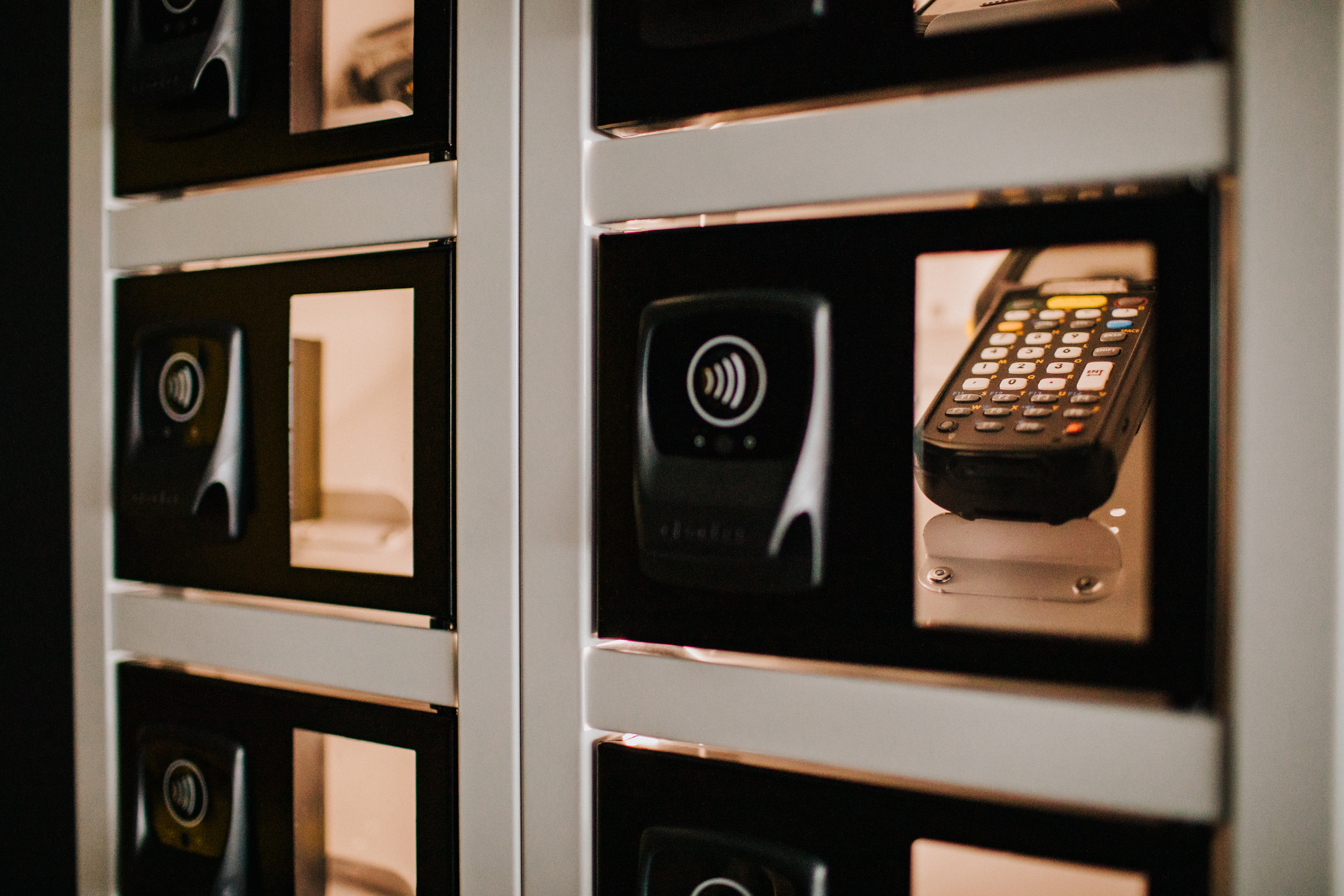
A practical guide to how warehouse smart lockers automate the issue and return of scanners, handheld devices, radios and other shared assets, helping operations improve accountability, reduce loss and get teams onto shift faster.
Walk through almost any modern warehouse or distribution centre and you will find technology everywhere. Handheld scanners, mobile computers, radios, printers and other devices have become fundamental to keeping goods and people moving.
Yet the way those devices are issued and returned can be surprisingly manual.
Equipment may be stored in a cage or cupboard, handed out by a supervisor and recorded on paper or a spreadsheet. At the end of a shift, the same process happens in reverse. Multiply that across hundreds of operatives, several shifts and thousands of working days, and a seemingly simple handover process can become a significant operational burden.
There is another problem. Once an asset leaves the cage, it can become difficult to establish who has it, whether it has been returned, what condition it is in or whether it will be available for the next shift.
Warehouse smart lockers are designed to automate that process. They provide secure, self-service access to shared equipment while creating a digital record of who collected what, when it was taken and whether it came back.
The locker is the physical handover point. The bigger opportunity is creating accountability around the assets moving through it.
What are warehouse smart lockers?
Warehouse smart lockers are secure, digitally controlled lockers used to manage the collection, return and storage of shared operational equipment.
They can be used for assets such as:
- handheld scanners and mobile computers;
- two-way radios;
- printers;
- headsets;
- tablets;
- laptops;
- tools; and
- other shared devices or equipment.
Instead of a supervisor manually handing equipment to each operative, authorised users can collect the device they need directly from a locker.
The transaction is recorded by the software, linking the user with the asset they have taken. When the equipment is returned, that event can also be recorded.
This gives the warehouse something that a traditional equipment cage, key cabinet or sign-out sheet struggles to provide: a reliable history of which person had which asset and when.
For operations managing large numbers of relatively expensive shared devices, that visibility can materially change the economics of asset control.
Why warehouse asset management becomes difficult at scale
A manual equipment process can work perfectly adequately in a small operation.
If 10 people need equipment and one supervisor knows everyone on the shift, distributing and recovering devices may not create much friction.
The economics change as the operation scales.
Consider a distribution centre with hundreds of operatives working across several shifts. At each changeover, large numbers of people may need scanners or other equipment at roughly the same time.
Someone has to prepare those devices, distribute them, record who has taken them and then make sure they come back.
Several problems begin to compound:
Devices get lost or damaged: Shared assets move between people throughout the day. If accountability is weak, establishing responsibility for a missing or damaged device can be difficult.
The eventual outcome is often another repair or replacement appearing in the operating budget.
Shift starts become bottlenecks
A warehouse operative cannot do productive work until they have the equipment required to do their job.
If 50 people arrive at one equipment cage and devices are issued one at a time, the handover itself becomes a constraint on how quickly the shift can start.
Supervisors become equipment administrators
Preparing, issuing, collecting, reconciling and chasing devices consumes management time that could be spent running the operation.
Nobody has a reliable live picture
A spreadsheet may tell you what should have happened. It does not necessarily tell you where every asset is right now.
Over time, these individual inefficiencies become part of the accepted cost of running the site.
Smart lockers are intended to make that cost visible and reduce the manual effort behind it.
How do smart lockers work in a warehouse?
The warehouse workflow is built around linking three things:
- a user,
- an asset,
- a transaction.
Before a shift, devices can be stored securely in the lockers and, where required, charged so that they are ready for use.
When an operative needs equipment, they authenticate using the site's approved access method. That might be the same employee badge or RFID credential they already carry.
The system identifies what the operative is permitted to collect and releases the appropriate compartment. The collection is then logged against that person.
At the end of the shift, the process operates in reverse. The operative identifies themselves and the device being returned, the appropriate compartment becomes available and the return is recorded.
A typical warehouse workflow therefore looks something like:
Device stored and charged → operative authenticates → assigned device collected → collection recorded → device used → operative returns device → return confirmed → device becomes available again
From the operative's perspective, the interaction should be straightforward.
For the management team, however, every successful transaction contributes to a much clearer picture of asset movement.
eLocker's warehouse workflow, for example, can use the employee's existing site access card for collection and combine the employee credential with a device scan during return. This creates a record of both who is returning the equipment and which specific asset has come back.
Creating accountability for shared devices
Accountability is arguably the most important difference between a warehouse smart locker and conventional secure storage.
Putting scanners in a locked cage keeps them secure while they are inside it. The harder problem begins when they leave.
If devices are distributed manually, the warehouse may rely on a sign-out sheet, spreadsheet or supervisor to maintain the relationship between user and asset. Those records can become incomplete very quickly in a busy operation.
A smart locker system records the transaction at the point where the asset changes hands.
That allows managers to answer questions such as:
- Who collected this device?
- When did they collect it?
- Has it been returned?
- Which devices are still outstanding?
- Which assets are available for the next shift?
- Are particular devices repeatedly associated with problems?
- Are there patterns in loss, damage or late return?
This does more than make investigations easier.
When users know that equipment is issued and returned against their identity, behaviour can change. Responsibility becomes clearer because the asset is no longer disappearing into an anonymous pool of shared equipment.
The current eLocker warehouse proposition is built around this principle of named collection and logged return, with every collection and return creating an audit trail.
How smart lockers can reduce device loss and damage
Warehouse devices are not inexpensive.
Industrial scanners, mobile computers, radios and printers are built for demanding environments, and replacing them repeatedly can create a substantial ongoing cost.
The problem is not necessarily theft. Equipment can be left in the wrong place, taken home accidentally, returned to a different location or damaged without anyone being able to establish what happened.
Weak accountability makes each of those situations harder to investigate.
Smart lockers create a known point of issue and return.
If a device has not come back, the system can show who last collected it. If an asset is overdue, it can be identified before several days have passed. If patterns emerge around particular devices or users, the data makes those patterns easier to see.
That does not make equipment impossible to lose or damage.
It makes loss and damage visible and attributable, which gives the operation a much better chance of preventing repeated problems.
Removing the equipment cage from the critical path
Asset control is only one part of the warehouse business case.
The other is time.
Shift change creates a particular operational challenge because many people need equipment simultaneously.
Imagine 50 operatives arriving for a shift. If they all collect devices from one staffed equipment cage, the process is inherently sequential. One person is served, then the next, then the next.
The people waiting are already on the clock, but they are not yet productive.
Smart lockers change the shape of that process because several people can collect equipment at the same time.
| Manual equipment issue | Smart locker collection |
| Central equipment cage or desk | Distributed self-service access |
| Supervisor required | Operative collects independently |
| Users queue at one handout point | Multiple collections can happen simultaneously |
| Manual sign-out | Transaction recorded automatically |
| Device availability checked manually | Availability visible through the system |
| Supervisor chases returns | Exceptions can be surfaced by the platform |
The objective is not simply to make collection more convenient. It is to get people equipped and onto the warehouse floor faster.
Did you know: eLocker's current warehouse modelling illustrates how material this can become. Our commercial solution models self-service collection as approximately 4.5 times faster than a single manual service point in a 50-person shift-change scenario.
The precise saving will vary from site to site, but the principle is straightforward: a few minutes multiplied by large teams, several shifts and hundreds of operating days becomes a measurable productivity cost.
Keeping equipment charged and ready for the next shift
Finding a scanner is not particularly useful if its battery is flat.
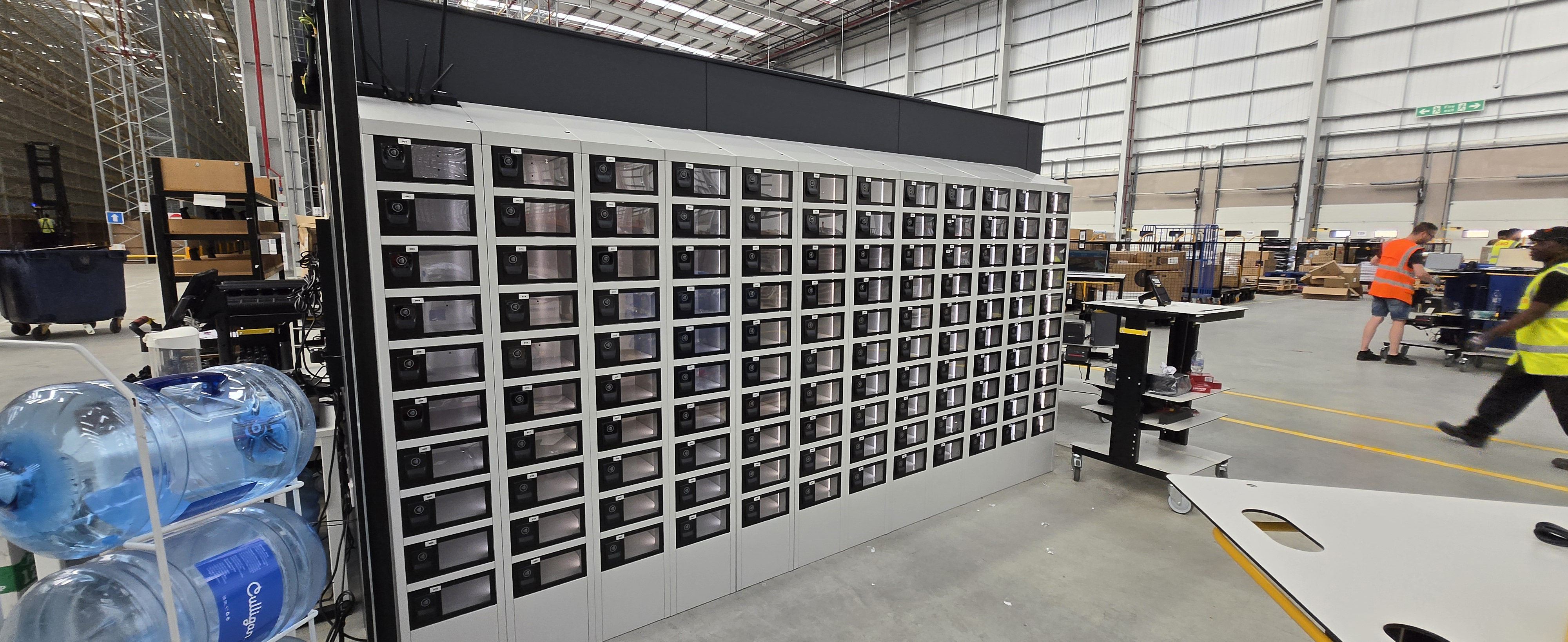
For rechargeable devices, smart warehouse lockers can include charging inside individual compartments. Equipment charges while securely stored rather than being separated into a different charging process.
This helps connect three requirements that are often managed independently:
- storage,
- accountability,
- readiness.
When an asset is returned correctly, the operation can know that it is back. When it is stored in a powered compartment, it can also be prepared for the next user.
This is particularly useful for assets that rotate continuously between shifts. It also reduces the likelihood of operatives informally searching for devices that happen to have enough battery life to get them through the day.
Charging is separate from powering the locker system itself, so the electrical requirements need to be considered as part of the installation design. eLocker supports in-locker charging for equipment such as scanners, radios and laptops where the workflow requires it.
Managing returns is as important as managing collections
It is easy to concentrate on getting equipment into an operative's hands at the start of a shift.
For asset control, the return process matters just as much.
A weak return process allows devices to drift out of circulation. Equipment may be left at workstations, handed to another operative or returned without a clear record of which specific asset has come back.
A controlled return should establish both the identity of the user and the identity of the asset.
This can create a closed loop:
known asset → known user → known collection → known return
If the loop remains open because something has not been returned, the system can surface the exception.
This moves warehouse teams away from periodic reconciliation towards active exception management.
Instead of asking “How many scanners appear to be missing this week?”, managers can identify which assets are outstanding and where the investigation should begin.
What happens when a device is not returned?
This is where digital asset control becomes particularly useful.
In a manual process, a missing device may not become apparent until somebody notices an empty charging slot, the next shift cannot find enough equipment or a periodic asset count reveals a discrepancy.
By then, establishing what happened can be difficult.
With a smart locker system, the transaction history provides a starting point.
The platform can identify equipment that remains outstanding or has not followed the expected return process. Managers can then concentrate on those exceptions rather than manually checking every successful transaction.
Depending on the workflow, exceptions might include:
- equipment not returned by the expected time;
- a device returned through the wrong process;
- damaged equipment;
- failed authentication;
- a door or lock issue; or
- equipment that repeatedly creates availability problems.
The technology does not remove the need for operational judgement. It makes it easier to know where that judgement is required.
What information can warehouse managers see?
Once collections and returns are digitised, the process begins to generate operational data.
That can provide visibility of areas such as:
- asset usage;
- current availability;
- collection and return histories;
- overdue equipment;
- exceptions;
- locker utilisation;
- patterns across shifts; and
- differences between sites.
For a single warehouse, this can improve day-to-day control.
Across a larger estate, it becomes more strategically useful. Operations teams can compare sites, understand asset requirements more accurately and identify where particular processes are creating unnecessary cost.
The management conversation can begin to move from:
“We think we're losing too many scanners.”
to:
“Here is what is happening to our scanners, when it happens and what it costs.”
That distinction matters when an improvement project needs to secure investment.
Where does the financial value come from?
The business case for warehouse smart lockers is rarely one large saving.
It is usually the cumulative effect of several recurring costs.
The principal areas tend to include:
- Fewer lost and damaged assets: Stronger accountability can reduce unnecessary replacement and repair expenditure.
- Less supervisor time spent managing equipment: Self-service collection and return reduces the hours spent preparing, distributing, recovering and reconciling devices.
- Faster shift readiness: Reducing queues and delays at the beginning of a shift gets operatives productive sooner.
- Less administration and investigation: A digital audit trail reduces the effort required to reconcile records and investigate missing equipment.
- Better utilisation of the existing asset pool: Greater visibility can help operations understand whether additional equipment is genuinely required or whether existing assets are simply poorly controlled.
These costs should be measured using the warehouse's own numbers rather than relying solely on industry averages.
Did you know: eLocker's current customer modelling indicates an average potential saving of around £80,000 per warehouse per year, based on areas including loss and damage, manual handout time, shift delays and administration. We treat this as an indicative figure and validates the economics against the individual site's operation.
That is the right way to approach the business case.
The question is not “How much does a smart locker cost?”
It is “How much is the existing asset-control process costing us?”
Are warehouse smart lockers difficult for operatives to use?
Any technology introduced into a warehouse has to survive contact with the actual shift. A process that looks elegant in a demonstration but adds steps for operatives is unlikely to deliver its intended benefit.
For that reason, the user journey should be designed around the environment rather than asking the workforce to adapt to the technology.
Where possible, this means using credentials people already carry and avoiding unnecessary interactions.
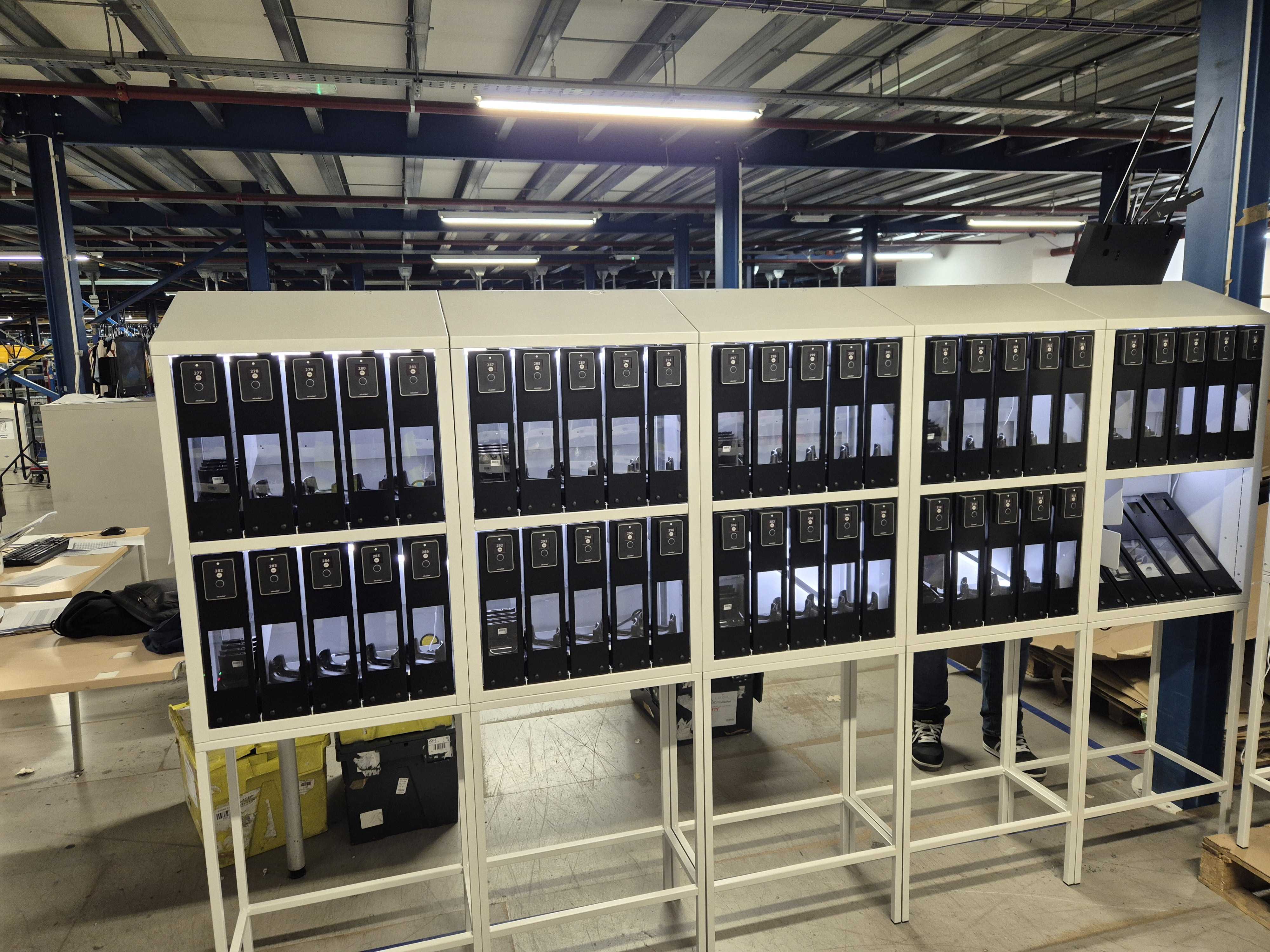
For example, eLocker's warehouse implementation can use existing site access cards for authentication, meaning workers do not need to take a phone onto the warehouse floor or learn a separate application simply to collect equipment.
The benchmark should be straightforward:
Is collecting and returning equipment easier than the process it replaces?
If the answer is no, the workflow needs more work.
Can warehouse smart lockers integrate with existing systems?
Yes, where the operational requirement justifies it.
A warehouse locker system can operate as a relatively focused asset-control workflow, or it can exchange information with other systems through integrations and APIs.
The appropriate level of integration depends on what the organisation wants to automate.
The important point is not to make integration a goal in itself.
If self-service issue and return, named accountability and exception reporting solve the majority of the operational problem, there may be little value in turning the first deployment into a large IT project.
A sensible approach is often to establish the asset-control workflow, measure the improvement and then identify where integration could remove further manual administration.
Which warehouse environments can use smart asset lockers?
The underlying problem appears across many types of warehouse and distribution operation.
Large third-party logistics providers may need to control equipment across several customers, shifts and contracts. Retail distribution centres may have significant seasonal peaks. Manufacturing and automotive operations can depend on shared equipment remaining available around the clock.
The configuration may change, but the core requirement remains similar: valuable shared equipment needs to be available to the right people without becoming difficult to control.
Warehouse smart lockers can therefore be relevant to:
- third-party logistics and contract logistics;
- retail distribution centres;
- ecommerce fulfilment;
- manufacturing;
- automotive logistics;
- parcel and carrier operations; and
- other multi-shift environments using shared operational assets.
The strongest use cases tend to occur where there are high user numbers, frequent asset movements, multiple shifts and a meaningful cost attached to lost time or equipment.
What should you consider before introducing smart lockers into a warehouse?
The starting point should not be deciding how many locker doors to buy. It should be understanding how equipment moves through the operation today.
Useful questions include:
- How many shared devices are in circulation?
- How many people use them?
- How are they currently issued and returned?
- How long does the process take at each shift change?
- How much supervisor time is involved?
- How many devices are lost, damaged or replaced each year?
- How are returns currently recorded?
- What happens when equipment is not returned?
- Does equipment need charging between uses?
- Which credentials do operatives already use?
- What information would managers find useful?
- Does the workflow need to connect with another system?
These questions establish the operational baseline.
Without that baseline, it is difficult to distinguish a technology purchase from a genuine process improvement.
A pilot can then test whether self-service asset control changes the metrics that matter before the approach is expanded across the site or wider estate.
Frequently asked questions about warehouse smart lockers
What is a warehouse smart locker?
A warehouse smart locker is a digitally controlled locker used to securely issue, return and manage shared operational equipment. Software records who collects and returns individual assets, creating a traceable asset-control process.
What equipment can be stored in warehouse smart lockers?
Common examples include handheld scanners, mobile computers, radios, printers, headsets, tablets, laptops and other shared devices or tools. Locker sizes and configurations can be adapted to the equipment being managed.
How do warehouse smart lockers reduce device loss?
Each collection and return can be linked to an identified user and specific asset. This creates accountability and gives managers a transaction history when equipment is not returned as expected.
Can warehouse smart lockers charge devices?
Yes. Where required, compartments can include charging so rechargeable equipment is stored securely and prepared for the next user.
Do warehouse workers need an app to use smart lockers?
Not necessarily. Systems can use existing employee credentials such as RFID access cards or badges, depending on the site's requirements and configuration.
Can several workers collect devices at the same time?
Yes. Multiple locker compartments allow several users to collect or return equipment simultaneously, helping remove the bottleneck created by a single staffed equipment cage.
What happens if a warehouse device is not returned?
The system retains the collection record and can identify the asset as outstanding or overdue, allowing the appropriate person to investigate.
Can smart lockers work across multiple warehouse sites?
Yes. A centrally managed smart locker platform can provide reporting and visibility across multiple sites, subject to the system and deployment configuration.
Can existing warehouse lockers be made smart?
Potentially. Where suitable locker infrastructure already exists, smart locking technology may be retrofitted rather than requiring the complete locker bank to be replaced.
How much can warehouse smart lockers save?
The saving depends on the site's existing loss and damage, labour requirements, shift delays and administrative burden. eLocker's current modelling indicates an average potential saving of around £80,000 per warehouse per year, but the business case should be calculated using the individual operation's own data.
Better asset control starts with the handover
Warehouse technology has become increasingly sophisticated, but seemingly small manual processes can still create disproportionate operational costs.
Shared-device management is a good example.
The problem is rarely the existence of the scanner, radio or mobile computer. It is everything required to get that asset into the right person's hands, recover it afterwards and know what happened in between.
Warehouse smart lockers turn that handover into a controlled self-service process.
Operatives can get the equipment they need without waiting for somebody to issue it. Supervisors spend less time administering devices. Collections and returns create an audit trail. Missing equipment becomes easier to identify. Devices can be stored securely and charged between shifts.
The result is not simply a better place to keep equipment. It is a more accountable way of managing the shared assets that warehouse operations depend on.