A practical guide to how retailers use smart lockers to automate collections and returns, reduce manual handovers and create faster, more scalable self-service experiences for customers.
Retail has spent years making the online part of shopping easier. Finding a product, placing an order and paying for it can now happen in minutes.
The physical handover is often less sophisticated.
A customer arrives to collect an online order and joins a queue. A colleague checks their details, walks to a stockroom, searches for the parcel and returns to complete the handover. For a return, another colleague may need to receive the item, verify it and begin the reverse process.
None of these individual interactions seems particularly onerous. The problem emerges at scale.
When thousands of orders and returns pass through a store estate, every colleague minute becomes part of the cost of serving the online customer. At peak periods, collection desks become congested, back rooms fill with parcels and a service designed around convenience can become another source of friction.
Retail smart lockers provide an alternative. They create a secure self-service handover point where customers can collect or return items without requiring a colleague to personally manage every transaction.
Their role, however, extends beyond Click & Collect. Smart lockers can support different retail formats, different types of goods and different customer journeys, making them part of a wider approach to automating how physical stores support omnichannel retail.
What are retail smart lockers?
Retail smart lockers are secure, digitally controlled compartments used to manage customer collections, returns and other retail handovers.
Unlike a conventional locker, access is managed through software. The retailer deposits an order, the customer is given permission to access the appropriate compartment and the transaction is recorded.
The same principle can work in reverse for a return.
The important distinction is that the locker is not simply somewhere to store a parcel. It becomes part of the customer journey and the operational process behind it.
For retailers, this means smart lockers can help connect three requirements that have traditionally competed with one another:
customer convenience, store efficiency and operational control.
The customer wants a fast and straightforward experience. The store needs to handle transactions without creating excessive workload. The retailer needs visibility of what has happened.
A well-designed retail locker system has to satisfy all three.
Why are retailers using smart lockers?
Click & Collect has changed the role of the physical store.
A store is no longer simply somewhere products are displayed and purchased. It may also operate as a collection point, return location and fulfilment node for orders that originated online.
That creates an operational challenge.
The customer may regard collection as a free service, but it is not free for the retailer to provide. Somebody still has to receive or prepare the order, store it securely, find it when the customer arrives and complete the handover.
As volumes grow, those small tasks become a repeatable cost.
There is also a customer-experience issue. Click & Collect is supposed to be convenient. If the customer has to queue at a service desk and wait while somebody searches for an order, some of that convenience disappears.
Smart lockers change the final stage of the journey by allowing more routine handovers to become self-service.
That does not mean removing colleagues from the customer experience. It means questioning whether a skilled retail colleague needs to personally manage every straightforward collection or return.
How do retail smart lockers work?
The precise workflow varies between retailers, but the principle is relatively simple.
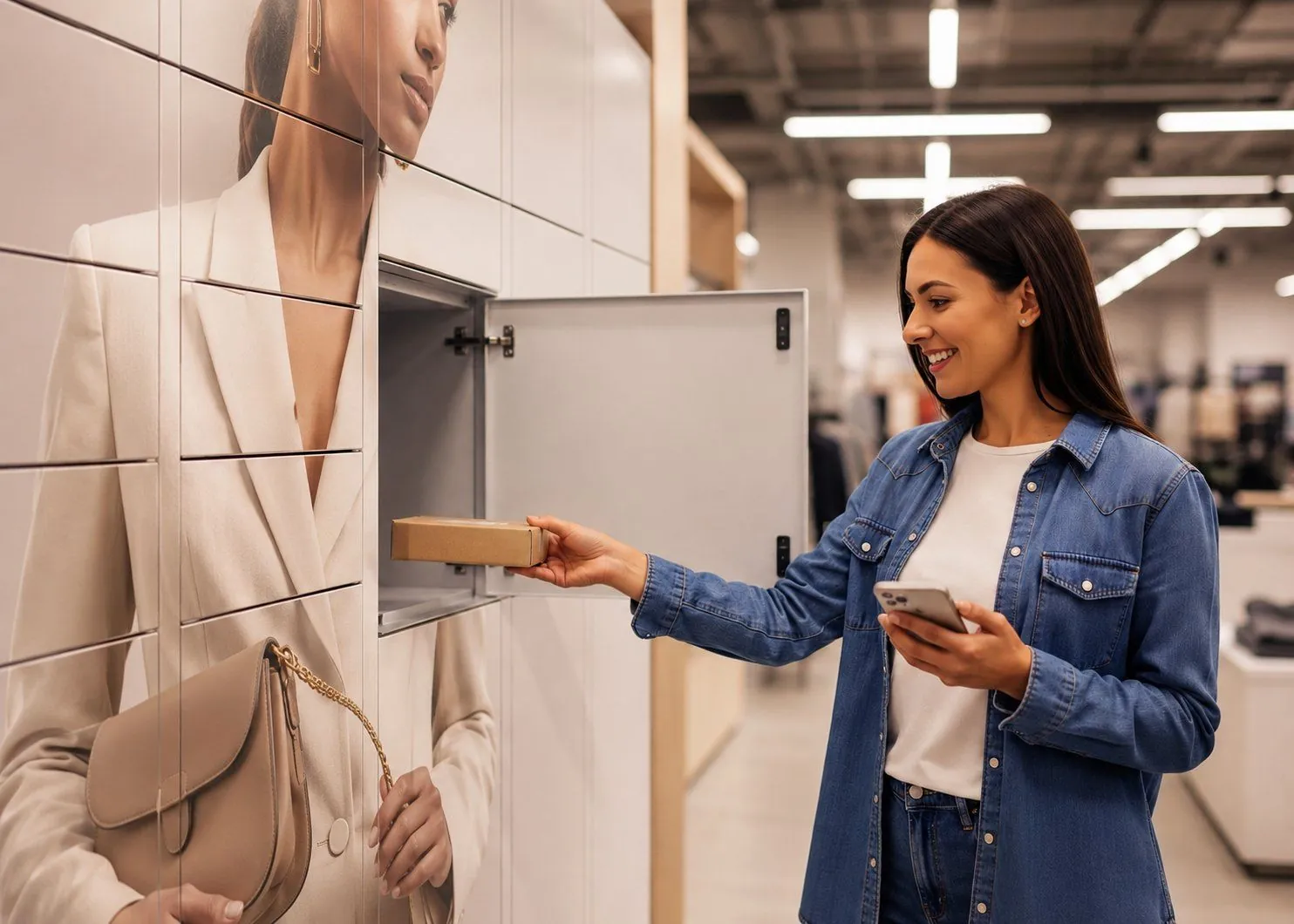
For a collection, an order is placed into an available compartment and associated with the customer. The customer is notified that it is ready and given an authorised way to access it. When they arrive, they authenticate and the appropriate locker door opens. The collection is then recorded.
A typical journey looks like:
Order ready → order deposited → customer notified → customer authenticates → correct door opens → order collected → transaction recorded
The customer does not need a colleague to locate and hand over the order.
For a return, the direction changes. The customer is authorised to deposit an item rather than collect one.
Return initiated → customer authorised → compartment allocated → item deposited → return recorded → retailer processes item
The underlying technology can therefore support items moving in both directions.
That becomes particularly useful for retailers looking beyond individual Click & Collect projects towards a more joined-up collections and returns model.
Click & Collect without the collection desk
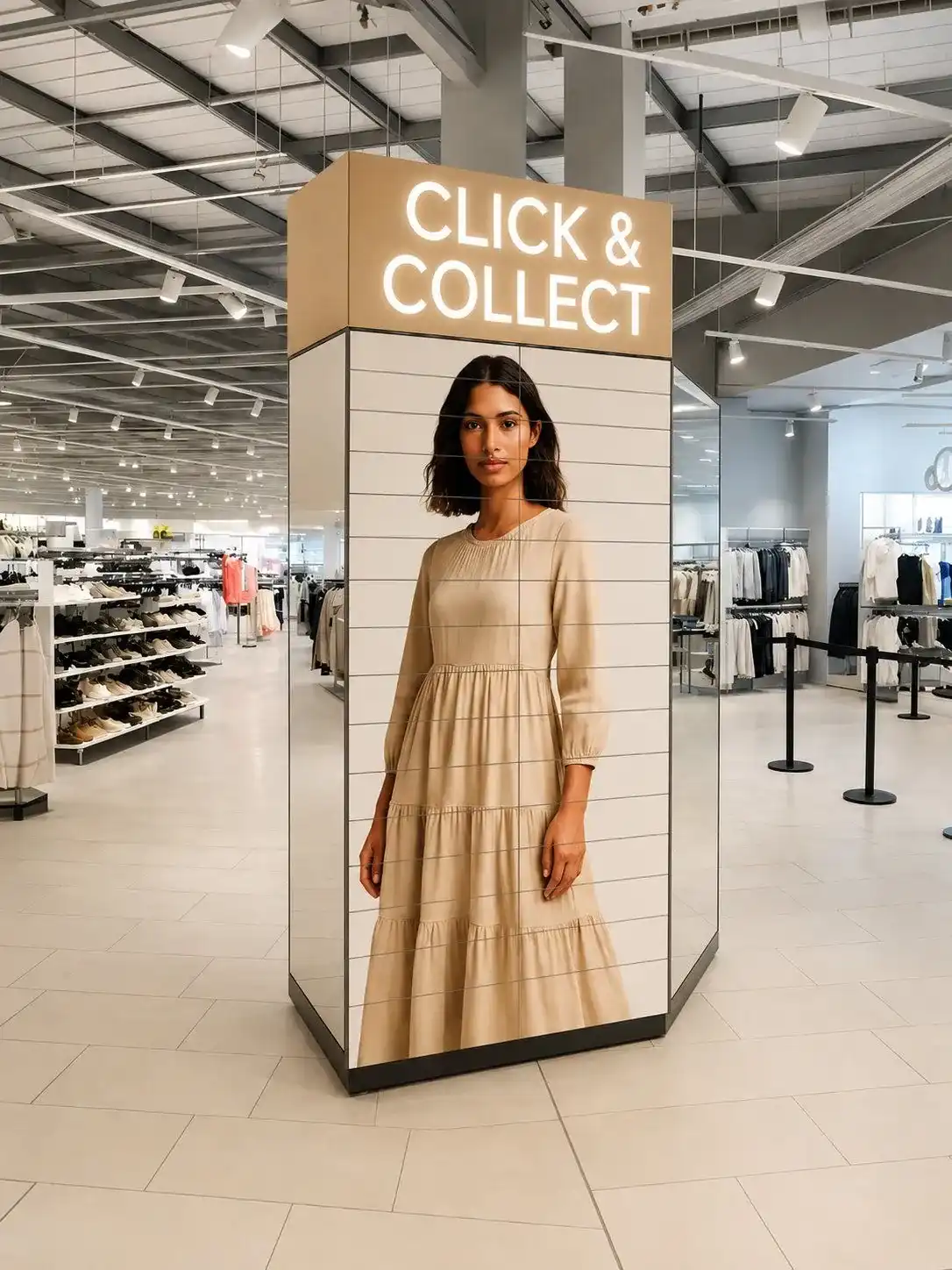
Click & Collect is the most familiar retail application for smart lockers.
The weakness in many traditional Click & Collect processes is not the click. Retailers have invested heavily in ecommerce, order management and fulfilment.
The friction frequently appears at the collect. A staffed collection desk creates a sequential process. The customer waits for a colleague to become available, the colleague retrieves the order and the handover takes place.
That works until volume increases. At peak, queues form and colleagues can be pulled away from other activities to manage collections. The operational cost also tends to rise with volume because every additional order creates another manual handover.
Smart lockers allow several customers to collect simultaneously. Once the order has been deposited, the final interaction no longer depends on a colleague being available. The customer can authenticate, open the appropriate compartment and continue with their visit.
This is why the business case is usually better understood as cost-to-serve and capacity, rather than simply convenience.
The retailer is changing how much human effort is required for each collection and how many collections a store can handle at the same time.
Using smart lockers for retail returns
Returns create many of the same operational challenges as collections, but in reverse.
A customer arrives with an item. A colleague may need to become available, receive it and begin the process of getting it back into the retailer's reverse-logistics operation.
For high-volume retailers, that can create another stream of transactions through service desks and customer-service areas.
Smart lockers allow suitable returns to become self-service.
The customer begins the approved return journey, authenticates and deposits the item into the allocated compartment. The event is recorded so the retailer has a clearer record of the handover.
This does not mean every retail return can or should be completely automated. Some products need inspection, some customer circumstances require assistance and exceptions will always exist.
The opportunity is to remove unnecessary manual involvement from routine returns, allowing colleagues to concentrate on situations where they genuinely add value.
There is also an important control benefit. Collections and returns can become difficult to investigate when physical items, customer interactions and system records do not align. A controlled locker workflow can create a clearer chain of custody and reduce some of that ambiguity. eLocker's existing work on collections and returns highlights this relationship between automation, traceability and operational risk.
How retail smart lockers can reduce cost-to-serve
One of the difficulties with manual collections is that much of the cost is hidden inside normal store labour.
Three minutes retrieving one parcel does not sound material. Neither does a colleague spending several minutes resolving a collection query.
Across hundreds of stores and thousands of transactions, the economics look different.
The true cost can include:
- colleague time spent retrieving and handing over orders;
- time managing queues and customer queries;
- back-room handling and organisation;
- manual checks and record keeping;
- management time resolving missing or disputed orders; and
- additional labour required as collection volumes increase.
Smart lockers do not remove every one of those costs. Orders still need to reach the store and be loaded into the locker.
What they can remove is much of the repetitive final handover.
This matters because it changes how cost behaves as volumes grow.
In a predominantly manual model, more collections generally require more colleague time. In a self-service model, transaction volumes can increase without the labour required for the final handover necessarily increasing at the same rate.
That is where smart lockers become a scalability proposition rather than simply a hardware purchase.
What do smart lockers change for the customer?
The operational case is important, but a retail technology that makes life easier for the store while making the customer journey harder is unlikely to succeed.
The experience needs to improve on the process it replaces. For most customers, that means reducing effort. They want to know when their order is ready, understand where to go and collect it without unnecessary steps. They should not need to understand the technology behind the locker.
A good smart locker journey can provide:
- a clear notification when the order is ready;
- self-service collection during available store hours;
- no need to find an available colleague;
- reduced queuing;
- secure access to the correct order; and
- a consistent process that becomes familiar with repeat use.
Importantly, self-service should not mean customer self-administration.
If a retailer simply transfers complexity from its colleagues to its customers, it has not improved the journey.
The best self-service experiences remove effort on both sides.
Keeping the customer visit within the retailer's estate
There is also a wider strategic consideration.
Retailers increasingly operate alongside third-party parcel and locker networks that offer consumers convenient collection locations.
Those services solve a genuine customer problem, but they can also move part of the customer journey away from the retailer.
When a customer collects an order from the retailer's own store, the visit remains within the retailer's physical estate. The customer is already in an environment where they can browse, purchase something else, resolve another need or engage with the brand.
This does not mean every collection will produce additional spend. Nor should a locker project be justified on an assumed halo sale that may never materialise.
But there is a strategic difference between using the store as part of the omnichannel journey and outsourcing that customer touchpoint completely.
Retail smart lockers can help stores fulfil that role without requiring every additional collection to create an equivalent increase in colleague workload.
Smart lockers for grocery collection
Grocery creates a more complex version of the same problem because not every item can be held at ambient temperature.
A grocery order may contain ambient, chilled and frozen products, all of which need to remain within the appropriate storage conditions until the customer arrives.
Temperature-controlled smart lockers allow retailers to combine these requirements within a collection environment.
The customer journey remains broadly similar: the order is prepared, the customer is notified and access is controlled digitally. The difference is that the physical locker configuration maintains the appropriate temperature for the goods inside.
This can allow grocery retailers to extend self-service collection beyond conventional ambient parcels while retaining a recorded collection process.
The locker system therefore adapts to the product rather than forcing every retail use case into the same physical configuration.
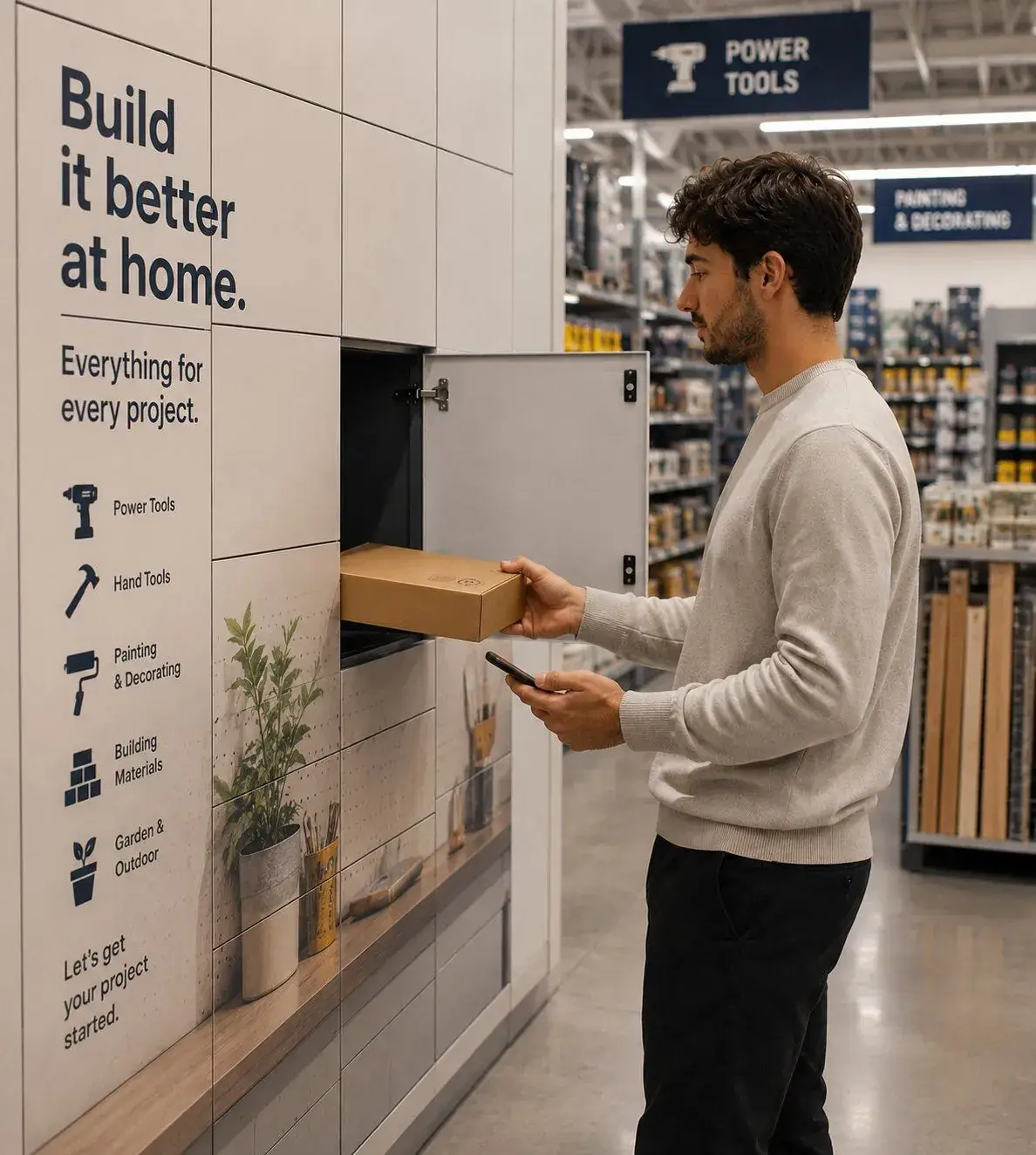
Smart lockers for trade and DIY collection
Trade, building supplies and DIY retailers face a different customer expectation.
A trade customer may be collecting goods before travelling to a job and can place a high value on speed. Waiting at a counter while an order is located can therefore create disproportionate frustration.
Smart lockers can allow appropriate pre-ordered goods to be collected through a self-service journey, reducing dependency on the trade counter for routine handovers.
The underlying principle is the same as mainstream Click & Collect, but the commercial context is different.
Convenience for a leisure shopper may save a few minutes. For a tradesperson, those minutes form part of their working day.
Locker configurations can also be adapted to different order profiles rather than relying entirely on conventional parcel-sized compartments.
The important question is not whether every trade order fits into a locker. It is whether enough repeatable collections can be automated to materially improve the operation.
Can retail smart lockers improve store capacity?
This is one of the more important benefits as collection volumes grow.
A staffed desk has a natural throughput limit. Even an excellent colleague can only serve one or a small number of customers at a time.
Self-service lockers create parallel capacity. Several customers can potentially collect from different compartments at the same time. That can make the collection process more resilient during busy trading periods without requiring the service desk to expand at the same rate.
The same principle applies across an estate.
A retailer trying to grow online sales through stores needs to ask whether its collection operation can absorb that growth. If every incremental order adds another manual handover, store capacity eventually becomes a constraint.
Smart lockers can help decouple transaction growth from handover labour.
That makes them particularly relevant where retailers are experiencing:
- increasing Click & Collect volumes;
- seasonal peaks;
- queues at collection points;
- limited service-desk capacity;
- pressure on store labour; or
- stores restricting collection capacity because the existing process cannot absorb more volume.
The commercial objective is not necessarily to use fewer people. It is to prevent a growing fulfilment channel from consuming an ever-greater proportion of store labour.
Improving control and traceability
Retail collections and returns also create a chain-of-custody challenge. An order moves from fulfilment into the store, through temporary storage and eventually into the customer's hands. A return travels in the opposite direction.
When those movements depend on shelves, manual records and colleague recollection, ambiguity can develop. A customer may believe they returned an item. The store may struggle to establish what happened. An order might be recorded as ready but cannot immediately be located.
Smart locker transactions create a digital event around the physical handover. Depending on the workflow, the retailer can have a clearer record of:
| Retail event | Information that can be captured |
| Order deposited | When and where it was loaded |
| Customer access | Authentication and access event |
| Collection | When the order left the locker |
| Return deposited | When the item entered the return workflow |
| Uncollected order | Transaction remaining outstanding |
| Exception | Event requiring investigation |
This does not eliminate disputes or operational errors. It gives the retailer better evidence when they occur. That can benefit store operations, customer service, loss prevention and finance because teams are working from a clearer transaction history rather than trying to reconstruct events after the fact.
How do retail smart lockers fit into the store?
There is no single correct locker configuration for retail.
A high-street fashion store has different requirements from a supermarket, trade counter or large-format retailer.
The design needs to consider factors such as:
- expected transaction volumes;
- typical order size;
- available floor or back-room space;
- customer access;
- accessibility;
- indoor or outdoor placement;
- ambient, chilled or frozen requirements;
- branding;
- store opening hours; and
- the collection and return workflows being supported.
The customer journey matters as much as the hardware. A locker positioned somewhere difficult to find or requiring a confusing access process can simply create a different form of friction.
The best deployments treat the locker as part of the store experience rather than as equipment that happens to have been installed in it.
Do retail smart lockers need an app or kiosk?
Not necessarily. Different smart locker systems use different methods of customer authentication. Some rely on a central kiosk or touchscreen. Others allow the customer to use their own phone through a secure browser journey, removing the need to download an app or queue at a shared screen.
Did you know: eLocker's retail collection workflow uses a mobile journey for customer access, while colleague-facing interactions can use existing credentials where appropriate.
The choice has implications for both customer experience and throughput.
A single kiosk can become another sequential point in the journey if every customer has to interact with it before opening a locker. A mobile-first approach allows different customers to complete their authentication independently.
The right model depends on the retailer, its customers and the environment.
Can existing retail lockers be made smart?
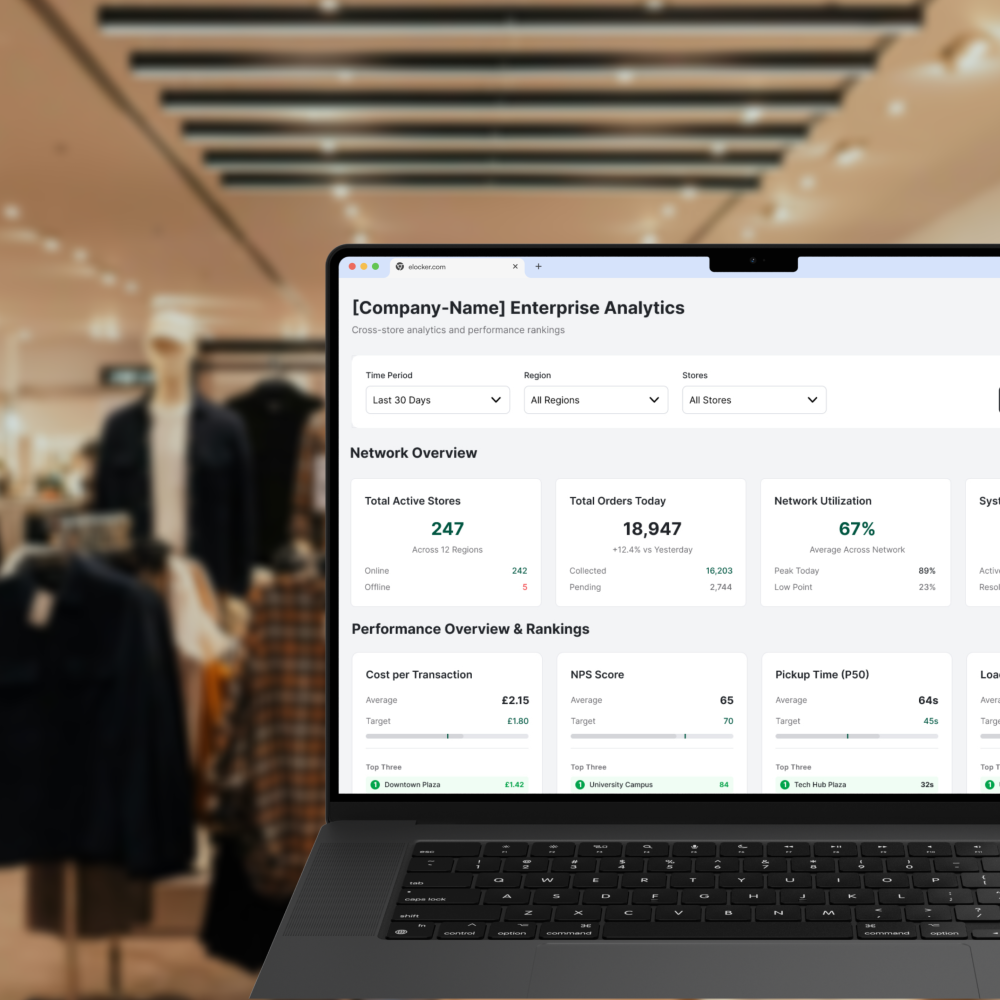
Potentially. Where a retailer already has suitable locker infrastructure, it may be possible to retrofit electronic smart locking technology and connect the existing compartments to management software.
That can be commercially attractive because it avoids replacing usable physical infrastructure simply to gain the digital workflow. Not every existing locker will be appropriate, so compatibility needs to be assessed.
But the wider principle is useful: the value of a smart locker system sits disproportionately in the access, software and workflow layer rather than the cabinet alone.
A retailer evaluating smart lockers should therefore consider both new hardware and whether any existing estate can form part of the solution.
How should retailers measure the business case?
A smart locker pilot should be measured against the process it replaces. The most useful baseline metrics will depend on the retailer, but typically include:
- collection volume;
- return volume;
- average colleague time per handover;
- customer waiting time;
- cost per collection or return;
- number of transactions that require intervention;
- failed or disputed handovers;
- space used to hold orders;
- peak-period throughput; and
- customer satisfaction with the journey.
This allows the retailer to compare the new process with its existing model using its own operating data. That is preferable to building an investment case around generic claims about convenience or labour savings.
A locker may reduce the time required for a transaction significantly, but the commercial value depends on how many times that transaction occurs and what the current process actually costs.
At estate scale, small improvements can become significant.
The arithmetic needs to begin at store level.
What should retailers consider before introducing smart lockers?
The first question should not be how many locker doors do we need?
It should be which customer handover are we trying to improve?
Retailers should understand:
- which collections or returns create the greatest friction;
- how much colleague time those transactions consume;
- where customers currently wait;
- how orders are stored before collection;
- what proportion of transactions are routine enough for self-service;
- which exceptions still require colleague support;
- what authentication journey will be easiest for customers;
- what data needs to be recorded;
- whether integration is required immediately;
- how the process will operate during peak periods; and
- how success will be measured.
That creates a much stronger basis for a pilot.
The objective should be to test whether automation improves the economics and customer experience of the handover, not simply whether customers are capable of opening a locker.
Frequently asked questions about retail smart lockers
What is a retail smart locker?
A retail smart locker is a secure, digitally controlled locker used to support customer collections, returns and other retail handovers. Access is managed through software and transactions can be recorded automatically.
What are retail smart lockers used for?
Common applications include Click & Collect, self-service returns, grocery collection and trade order collection. The precise workflow and locker configuration depend on the retailer and the goods being handled.
How do smart lockers work for Click & Collect?
The retailer deposits the prepared order into a secure compartment and the customer is notified. The customer authenticates, the correct door opens and the collection is recorded. eLocker's dedicated Click & Collect guide covers this process in more detail.
Can customers return items through smart lockers?
Yes. Suitable returns can be deposited through an authorised self-service workflow, creating a record of when the item entered the retailer's return process.
Can smart lockers handle chilled and frozen groceries?
Yes. Temperature-controlled locker configurations can support ambient, chilled and frozen goods, allowing grocery orders to remain at appropriate temperatures until collection.
Do customers need to download an app?
Not necessarily. Smart locker systems can use browser-based mobile journeys, PINs, QR codes or other authentication methods depending on the solution.
Can multiple customers use retail smart lockers at the same time?
Yes. Different customers can access separate compartments simultaneously, which can increase throughput compared with a single staffed collection point or shared kiosk.
Are retail smart lockers secure?
Smart lockers use controlled access so customers can only open the compartment associated with their transaction. Activity can also be logged, creating an audit trail around collections and returns. eLocker covers the wider physical, digital and data-security considerations in its dedicated smart locker security guide.
Can existing lockers be converted into retail smart lockers?
In some cases. Suitable locker banks may be retrofitted with smart locks and connected to software rather than being completely replaced.
Can retail smart lockers integrate with ecommerce systems?
Yes. Integration can allow locker activity to become part of a wider order or returns workflow. However, the required level of integration depends on the retailer and it may be possible to begin with a more contained pilot.
Smart lockers are ultimately about improving the handover
Retail smart lockers are easy to describe as a piece of store technology.
That understates their role. The more useful way to think about them is as infrastructure for managing the point where a digital transaction becomes physical.
An ecommerce order has to reach the customer. A return has to move back into the retailer's operation. A grocery order has to remain secure and at the correct temperature. A trade customer wants to collect what they need and continue with their working day.
Traditionally, a retail colleague has often been the person holding those processes together.
Smart lockers allow more routine handovers to become secure, traceable self-service transactions while keeping colleagues available for the interactions where their time genuinely adds value.
For retailers, that creates a broader opportunity than simply removing a collection queue. It can reduce manual cost-to-serve, create capacity for higher transaction volumes, improve traceability and make the physical store a more efficient part of the omnichannel customer journey.
The locker is the visible part.
The real value comes from making the handover work better for the customer and the retailer at the same time.