


In a busy warehouse, a missing handheld scanner rarely looks like a major productivity problem. One operative spends a few minutes looking for another device. A supervisor opens the cage. Someone borrows a scanner from another area. The shift gets moving, and the incident disappears into the day.
That is why the cost is so easy to underestimate. The problem is rarely one lost device. It is the accumulated labour time around equipment that is missing, unavailable, damaged, uncharged or simply not where the next shift expects it to be.
Across tens or hundreds of people, multiple shift changes and hundreds of operating days, those minutes can become a material productivity cost. The difficult part is proving it.
The short answer: measure the time between clock-in and productive work
If you want to know whether missing devices are affecting labour productivity, do not start by counting lost scanners. Start by measuring what happens to labour when the right equipment is not available.
Look at time spent waiting, searching or queueing for devices; the gap between shift start and first productive activity; how often devices are unavailable, damaged or uncharged; supervisor time spent locating, issuing and reconciling equipment; and whether affected shifts need more labour time or struggle to hit expected throughput.
Then compare those measures with shifts or periods where device availability is good.
The key distinction is between device loss as an asset problem and device availability as a labour problem. A scanner does not need to disappear permanently to cost the business money. If it is unavailable when somebody needs it, productivity has already been affected.

A device does not have to be permanently lost to create a labour cost. It only has to be unavailable when somebody is being paid to use it.
Why device-related productivity loss is difficult to see
Warehouses already measure a great deal: units picked, orders packed, lines per hour, accuracy, overtime and labour against plan. What is often less visible is the time before productive work begins.
Someone may clock in at 6am, but their first operational scan does not happen until several minutes later. Perhaps they were queueing for a device. Perhaps the scanner they were allocated was flat. Perhaps the previous shift did not return enough equipment. Perhaps a supervisor was trying to work out who last had a missing unit.
The labour system records the paid time. The warehouse system records the task. The friction between the two can go largely unmeasured.
That matters because shared devices sit directly in the path of productive work. If an operative needs a scanner, printer, radio or wearable device to do the job, device readiness is part of labour readiness.
This becomes especially important when headcount increases for seasonal demand. Permanent teams often develop informal workarounds. Experienced colleagues know where spare devices live, which units are unreliable and who to ask when something goes missing. Temporary workers do not.
As headcount rises, those informal systems come under pressure. The question is no longer simply, “Do we own enough scanners?” It becomes: Can we reliably put a working device into the right person’s hands when the shift needs it?
Measure lost productive minutes, not just lost assets
A common mistake is to build the business case around replacement cost alone. Lost and damaged devices matter, but for many operations, the recurring labour cost surrounding weak device control is just as important.
Suppose 100 colleagues each lose 3.6 minutes at shift change through waiting, collection or device-readiness friction. Across three shifts a day and 363 operating days, that represents 6,534 paid labour hours a year.
At the National Living Wage of £12.71 an hour introduced in April 2026, that is more than £83,000 of labour time, before employer on-costs. The rate will change over time, but the principle will not: paid minutes lost to avoidable friction become more expensive as labour costs rise.
That does not mean every recovered minute becomes a hard cash saving. The value may instead show up as additional capacity, less overtime pressure, better peak resilience or more output from the same labour base.
A credible business case should separate those outcomes. That matters to a General Manager who needs to know whether the improvement changes site economics, not simply whether the process looks better.

Five measures that show whether devices are dragging productivity
The most useful analysis connects device availability with operational performance.
1. Measure the true shift-start delay
Do not just measure when somebody clocks in. Measure when they become productive.
For scanner-dependent roles, a useful metric is the gap between clock-in and first successful operational scan. Track whether that delay comes from waiting for equipment, searching for equipment, receiving faulty or uncharged kit, manual allocation or sign-out, or late return from the previous shift.
The question is simple: How much paid time exists between “employee present” and “employee operational”?
That becomes especially important during peak, when the process has to support more people without creating more delay.
2. Measure device availability at the moment of demand
Knowing that the site owns 120 scanners is not enough. The better question is: How many working, charged and accessible devices are available when 100 people arrive for shift?
A warehouse can own enough equipment and still fail to deploy it effectively. If devices exist but cannot be accessed when needed, the problem may be control rather than purchasing.
That distinction matters because buying more equipment will not fix a broken process.
3. Capture supervisor intervention
Some of the least visible labour waste sits with managers. How often does a supervisor have to open an equipment cage, find a missing scanner, investigate who last used it, check a sign-out sheet, locate a replacement, or deal with damaged or uncharged equipment?
Those interruptions take management time away from running the shift.
For a continuous-improvement leader, this belongs in the baseline. Better asset control should not just improve reporting. It should remove unnecessary management work.
4. Connect device problems with shift performance
Once you have a device baseline, compare it with operational outcomes. Do shifts with greater equipment delays start later? Does overtime increase? Does the team miss labour plan? Does throughput recover later in the shift, suggesting the operation spent the opening period catching up?
Correlation is not proof on its own. Productivity can be affected by volume, staffing mix, congestion, system performance and task profile.
That is why comparisons should be made across reasonably similar shifts and workloads. You are looking for a repeatable operational signal, not a convenient statistic.
5. Measure the before-and-after result
The strongest evidence is not a theoretical ROI model. It is the same operation measured before and after the process changes.
Establish a baseline for shift-change time, first productive activity, missing-device incidents, damage incidents, device availability, supervisor administration, and overtime or additional labour where relevant. Then measure the same things again.
This is where traceability and accountability become commercially useful. If each collection and return is associated with a specific user and device, the operation gains data it previously lacked. It can see what was collected, what came back, when exceptions occurred and whether availability improved.
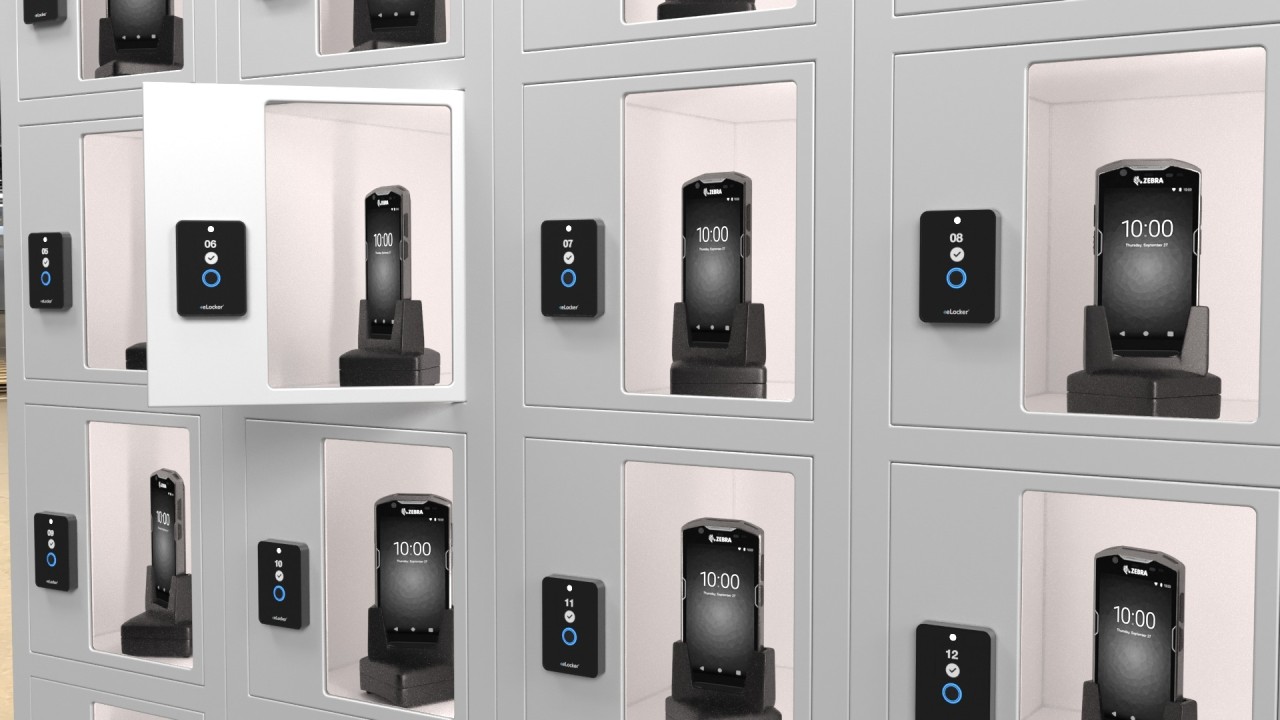
At GXO’s Nestlé operation, the previous process relied on paper records and access through a key-controlled cage. Moving to RFID-based self-service asset access created a digital record while removing dependence on a manager to release equipment.
The important point is not the locker. It is that the handover becomes measurable.
Peak exposes processes that normal operations can hide
Device-management weaknesses often become most obvious when volume and headcount rise together.
During quieter periods, the warehouse can absorb inefficient handovers. A supervisor finds another scanner. An experienced operative knows where the spares are. Five people waiting does not destabilise the shift.
Peak changes the arithmetic. More people arrive together. Temporary workers have less site knowledge. More devices move between more users. Equipment has less recovery time between shifts. A late return by one team becomes a shortage for another.
And because labour is being added specifically to increase capacity, paying additional colleagues to wait for equipment undermines the purpose of that investment.
That is why peak preparation is the right moment to examine device readiness, not the week the warehouse reaches maximum volume.
Before additional workers arrive, the operation should be able to answer four questions: Do we have enough devices? Will they be charged and available at shift start? Can we identify who has each device without asking around? Can a larger group collect equipment without creating a queue?
If the answer depends on memory, paper, keys or a particular supervisor being present, the process deserves attention.
Accountability should remove friction, not create surveillance
There is an important people consideration too. Better device accountability works because the warehouse can associate an asset with the person who collected it.
That improves traceability, but implementation matters. In unionised or culturally sensitive environments, a system positioned as employee monitoring can create unnecessary resistance.
The purpose should remain operational. Who collected the device? Was it returned? Was it available for the next shift? Where are loss and damage recurring?
That is very different from trying to monitor every minute of an employee’s day. If colleagues can see that better device control means less queueing, fewer disputes over missing equipment and a faster start to their shift, the conversation becomes much more constructive.
The goal is not to measure people more aggressively. It is to stop a badly controlled device process stealing productive time from them.
The business case has to survive scrutiny
For a continuous-improvement manager, finding the waste is only the first step. The harder test is whether the evidence will stand up to a General Manager, finance team, customer or procurement function.
A warehouse leader will want to know whether the saving is real, whether it improves site economics, whether operatives will use the process, and whether implementation will create more disruption than it removes.
In a 3PL, there may be another question too: Can the improvement be demonstrated clearly enough to the customer?
That is why the strongest business case is not simply, “We lose scanners.” It is: Here is how much productive time the current process consumes. Here is the direct cost of loss and damage. Here is the management time involved. Here is what happens when headcount rises. Here is how we will prove whether the new process works.
That turns asset control from an operational complaint into a measurable improvement programme.
Do not wait for a device crisis
The best time to measure device-related productivity loss is before the operation is under maximum pressure.
If peak hiring is approaching, establish the baseline while conditions are still relatively stable. Measure shift starts. Record device availability. Capture first productive activity. Quantify supervisor intervention. Track loss and damage separately.
Then model what happens when headcount rises.
The analysis may show the process is already good enough. If so, you have evidence. It may instead show that a few apparently harmless minutes are being multiplied into thousands of paid hours every year. That is useful evidence too.
The real question is not “How many devices have we lost?”
Missing equipment is easiest to notice when somebody has to replace it. Productivity loss is quieter.
It sits in the queue before shift start, in the search for a scanner, in the supervisor leaving the floor to open a cage, and in the temporary worker waiting for somebody to find usable equipment.
That is why counting missing devices is not enough.
If you want to know whether they are affecting labour productivity, measure the labour around them. Measure the time between arrival and productive work. Measure availability at the point of demand. Measure supervisor intervention. Connect those signals with shift performance. Then compare the same measures after the process changes.
Once those numbers are visible, the conversation changes. You are no longer asking whether device management is irritating.
You can decide, with evidence, whether it is important enough to fix.
If you are considering asset management for your workplace, get in touch with the team so we can talk through your use case and see how eLocker can help.