A practical guide to smart locker security, covering physical protection, user authentication, access control, data security and the digital audit trail behind every locker transaction.
Security is an obvious consideration when organisations start evaluating smart lockers. Whether the lockers are being used for customer orders, warehouse equipment or workplace IT assets, they are being trusted to hold items securely until the right person is authorised to collect them.
It is tempting, therefore, to judge security primarily by the physical locker: the strength of the cabinet, the construction of the door and the electronic lock keeping it closed. Those things matter, but they are only one part of the security model.
A smart locker is a connected system combining physical storage with electronically controlled access, software, user authentication and transaction data. Depending on the application, it may also connect with other business systems. Assessing how secure a smart locker is consequently requires consideration of both the physical and digital environment surrounding it.
A useful way to approach this is through four related areas: physical protection, identity and access control, data and system security, and auditability. The strongest smart locker deployments consider all four rather than relying on any individual security feature.
Physical security is only the starting point
At the most fundamental level, a smart locker still has to perform the same job as any other secure enclosure: prevent unauthorised access to whatever has been placed inside it.
Commercial smart lockers are typically constructed from materials such as steel and designed to withstand the repeated use expected in retail, warehouse and workplace environments. Electronic locks control individual compartments and remain secured until the system receives an authorised instruction to release them.
No physical locker should be regarded as impossible to breach. Given sufficient time, equipment and determination, most physical security measures can potentially be defeated. The more practical objective is to make unauthorised access sufficiently difficult, time-consuming and conspicuous to provide an appropriate level of protection for the assets being stored.
What constitutes an appropriate level of protection depends heavily on the environment. A customer collection locker positioned in a busy retail store has a different risk profile from a locker containing corporate laptops inside an access-controlled office. A warehouse installation managing a large pool of expensive handheld computers introduces another set of considerations.
This means physical security cannot sensibly be assessed in isolation. Organisations need to consider the value and sensitivity of the items being stored, who has access to the surrounding location, how long items are likely to remain in the lockers and what additional security controls already exist around them.
Electronic access changes the security model
The more significant difference between a conventional locker and a smart locker appears when the door needs to be opened.
Traditional lockers normally depend on physical keys or combinations. These can provide effective access control, but they also create practical limitations. Keys can be lost, copied or passed between users, while shared combinations can become known by more people than originally intended. Changing access may also require physical intervention.
A smart locker replaces much of this model with electronically controlled access. Instead of possession of a key determining whether somebody can open a compartment, the software can establish who the user is and whether they are authorised to complete a particular transaction.
This allows access to become much more specific. A retail customer can be authorised to access the compartment containing their order without gaining access to any other compartment. A warehouse operative can be permitted to collect the particular device assigned to them, while an employee collecting a replacement laptop can be given access only to the compartment associated with that exchange.
Access therefore becomes connected to an identity or transaction rather than simply to possession of a physical key.
How smart lockers authenticate users
Different environments require different approaches to authentication. An employee may already have an RFID badge or workplace access credential, while a retail customer may be better served by a secure mobile journey associated with their order. Other systems may use one-time credentials or additional authentication methods depending on the security requirements of the application.
The choice of authentication method needs to balance security with usability. Requiring unnecessary steps can make a routine locker transaction frustrating, while weak authentication can undermine the protection the locker is intended to provide.
This is particularly important because authentication and authorisation perform different functions. Authentication establishes the identity of the person attempting to use the locker, while authorisation determines what that person is permitted to access.
An employee successfully identifying themselves with their workplace credential should not automatically gain access to every locker in the building. The system still needs to establish whether they have permission to open a particular compartment at that particular time.
This ability to apply granular permissions is one of the important advantages of software-controlled access. Permissions can be linked to a specific user, transaction, locker or period of time, and they can be amended or removed centrally as circumstances change.
Why individual access is more useful than shared credentials
Shared keys and PINs can appear operationally convenient, particularly when several people need access to the same equipment. The security weakness is that they make individual accountability more difficult.
If several warehouse employees know the combination to an equipment cupboard, for example, establishing who removed a missing scanner can be difficult even if the cupboard itself remained securely locked until somebody entered the correct code.
Identity-based access creates a stronger relationship between the user and the transaction. When a specific person authenticates before collecting a specific asset, the system can associate the two.
This does not prevent equipment from subsequently being lost or damaged, but it provides a much clearer record of responsibility. In environments where valuable shared assets regularly move between users, that accountability can be as important as the physical security of the locker itself.
Data security matters because smart lockers are connected systems
Once lockers become connected, cybersecurity becomes part of the security assessment.
The platform may process information about users, access permissions, transactions and locker activity. It also needs to communicate securely with the locker hardware and, in some deployments, exchange information with other enterprise systems.
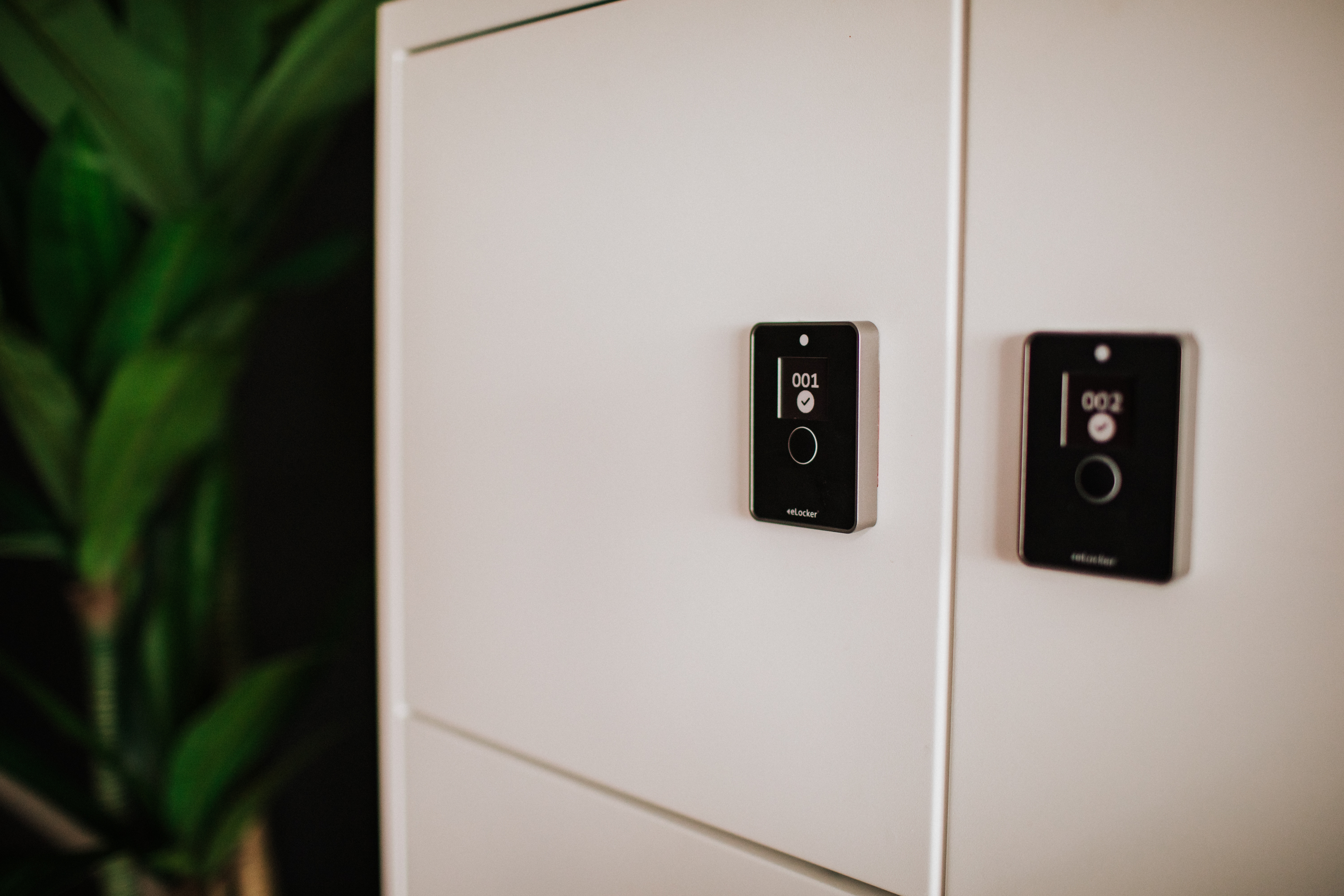
Encryption is therefore one part of the security architecture. eLocker uses AES encryption for communication between its locks and also operates an ISO/IEC 27001-certified information security management system.
The distinction between those two controls is important. Encryption helps protect information as it is communicated, while ISO/IEC 27001 addresses the wider management framework used to identify and manage information-security risks. Security depends on the technology being used and on the policies, processes and controls around it.
For IT, security and procurement teams, due diligence should consequently extend beyond the locker hardware. They need to understand how the overall platform is secured, how information is handled and what evidence the provider can supply to support its security claims.
What should organisations ask about smart locker cybersecurity?
The level of technical due diligence will vary according to the deployment. A relatively contained locker installation may warrant a different assessment from a multi-site enterprise system integrated with corporate identity, IT service management or ecommerce platforms.
In either case, the smart locker should be treated as connected technology rather than simply as furniture with an electronic lock. Organisations may need to understand how communications are protected, how users and administrators are authenticated, how permissions are managed and revoked, what information is stored and who can access it.
They should also consider how software updates and vulnerabilities are managed, what happens if connectivity is interrupted and how integrations with other systems are secured. Information-security certifications can provide useful supporting evidence, but they should form part of a wider assessment of the supplier and platform rather than being treated as proof that every deployment is automatically secure.
The precise questions will depend on the organisation's own risk-management and procurement requirements. What matters is that digital security receives the same attention as the physical cabinet.
The importance of the audit trail
One of the most valuable security differences between a conventional locker and a smart locker appears after somebody has gained legitimate access.
A traditional locker can protect an item while the door remains closed, but it may provide very little information about what happened once somebody used the key. A smart locker can create a digital record of the transaction.
Depending on the workflow, this record can include the identity of the user, the compartment accessed, the date and time, the asset or order associated with the transaction and whether an item was collected or returned. If something subsequently goes missing or a transaction is disputed, the organisation has a history to investigate rather than relying solely on recollection or manual records.
As eLocker Operations Director Billy Whiffen explains:
“The question we get asked most is never about the steel. It is whether you can prove who opened a door and when. With a smart locker you can, and that record is what turns a locker from locked into accountable.”
This distinction between being locked and accountable is particularly relevant in commercial environments. Security is not solely about preventing every possible incident; it is also about creating sufficient control and evidence to understand what happened when something does not follow the expected process.
Accountability can influence behaviour as well as investigations
The audit trail is useful when investigating a missing asset or disputed transaction, but its value is not entirely retrospective.
Shared equipment often becomes difficult to control when individual responsibility is unclear. If warehouse scanners, radios or workplace IT devices are taken from a communal storage area, users may have little sense that a particular asset has been assigned directly to them.
Recording the handover against an identified user makes that responsibility clearer. The organisation knows who collected the asset, and the user knows that the transaction has been recorded.
That does not guarantee that equipment will never be lost or damaged, but it can change the conditions in which those losses occur. More importantly, if an item is not returned, the organisation has a specific transaction from which to begin its investigation.
The security value therefore comes from connecting the person, the asset and the event rather than simply keeping equipment behind a locked door.
Managing permissions throughout the user lifecycle
Access permissions need to remain current if they are to provide meaningful security. Employees join and leave organisations, change roles and move between locations. Temporary access requirements expire, while retail collection permissions may only need to exist long enough for one customer to complete one transaction.
Software-controlled access makes it possible to manage those changes centrally. Rather than recovering a key or changing a shared combination, access can be amended or removed within the platform.
This can also allow permissions to be narrower. A retail customer does not need general access to a locker bank; they need permission to open one compartment associated with one order. An employee collecting a replacement laptop needs access to the relevant transaction rather than permanent access to an IT equipment store.
Limiting access to what a user genuinely needs reduces unnecessary exposure and creates a clearer security model.
Administrative access needs protecting too
The security conversation should not stop with the person standing in front of the locker.
Administrators may have considerably broader permissions within the management platform. Depending on their role, they may be able to manage users, create transactions, change access permissions, inspect records or configure locker systems.
Those capabilities are necessary to operate the platform, but they also mean administrative access needs appropriate protection.
Organisations conducting security due diligence should therefore understand not only how end users authenticate at the locker, but how privileged access to the management platform is controlled. The principle is the same as with other business systems: users should have the level of access required to perform their role without being given unnecessary privileges.
Are smart lockers more secure than traditional lockers?
There is no meaningful universal answer because the quality of both systems and the context in which they are deployed matter.
A well-built conventional locker with carefully controlled keys can provide strong physical protection. Smart lockers do not make the fundamental principles of physical security obsolete.
Their advantage lies in extending the security model beyond the physical lock.
A traditional key largely demonstrates that the person opening the locker possesses the key. A connected smart locker can potentially establish who the person is, determine whether they are authorised to access a particular compartment and create a timestamped record when they do so.
That combination of identity, permission and auditability provides a level of control that is difficult to achieve through mechanical locks alone.
The most useful comparison is therefore not simply whether an electronic lock is stronger than a mechanical one. It is whether the organisation needs to know and control who can access what, under which circumstances, and what happened afterwards.
Do smart lockers need CCTV?
CCTV and smart locker audit trails solve different security problems.
A smart locker platform records activity within the system. It can show that a particular transaction resulted in a compartment being accessed at a particular time. CCTV can provide visual evidence of activity in the surrounding physical environment.
Whether cameras are appropriate depends on the location, risk profile and the organisation's wider security policies. A publicly accessible retail location may be treated differently from a locker installation inside an office that already has controlled building access.
CCTV is therefore not an inherent requirement for a smart locker to operate securely. Where it is used, it should be regarded as an additional physical-security layer rather than a substitute for controlled locker access and transaction records.
Security also includes system availability
Cybersecurity is often discussed primarily in terms of preventing unauthorised access, but availability also matters.
A locker system can be highly effective at keeping unauthorised users out and still create a serious operational problem if legitimate users cannot gain access when they need it.
This is particularly relevant in environments where lockers form part of a business-critical workflow. A warehouse operative may need a scanner before beginning a shift, while an employee may be waiting for a replacement laptop before they can resume work.
Organisations should therefore understand how the system behaves if network connectivity or another supporting service becomes temporarily unavailable. The precise answer will depend on the platform and configuration, but resilience, recovery and continuity should form part of the security assessment where operational availability is important.
Security requirements depend on what the locker is being used for
The underlying smart locker technology can be deployed across retail, warehouse and workplace environments, but the risks are not identical.
In retail, security may centre on ensuring that a customer can only access the order associated with their collection transaction and that there is a clear record of the handover.
In a warehouse, the focus may be on controlling access to expensive shared devices and maintaining accountability as equipment moves between shifts and operatives.
For workplace IT, lockers may contain laptops, phones and other equipment associated with corporate systems and data, placing greater emphasis on identity, asset control and alignment with the organisation's wider information-security policies.
This is why a generic statement that a smart locker is “secure” has limited value. The appropriate question is whether the physical, access and digital controls are proportionate to the particular risk being managed.
How eLocker approaches smart locker security
eLocker's security model combines physical locker security with electronically controlled access, software-managed permissions, encrypted communications and transaction records.
Depending on the application, users can access lockers through existing credentials or a secure digital journey rather than relying on shared physical keys or combinations. The platform can then record activity associated with the transaction, providing an audit trail when equipment, orders or other assets move through the lockers.
At the information-security level, eLocker operates an ISO/IEC 27001-certified information security management system and uses AES encryption for communication between its smart locks. eLocker also holds Cyber Essentials Plus certification and provides a Trust Centre where organisations conducting technical, security and procurement due diligence can review relevant information.
The significance of these measures is in how they work together. Strong physical hardware provides only part of the answer if access cannot be controlled effectively, while authentication provides less assurance if the connected platform and information surrounding it are not appropriately protected.
Security therefore needs to be considered as a system rather than a collection of individual features.
What should organisations consider before deploying smart lockers?
The appropriate security specification should begin with the risk rather than with the locker.
An organisation storing relatively low-value customer orders in a supervised retail environment may reach different conclusions from a business distributing expensive IT equipment across remote offices. Understanding the assets, users and environment first makes it easier to determine which controls are genuinely required.
Before deployment, organisations should establish what will be stored, who needs access, how those users will be authenticated, how frequently permissions change and what transaction records need to be retained. They should also understand who will administer the platform, whether the lockers need to integrate with other business systems and what should happen if connectivity is temporarily unavailable.
For larger or more sensitive deployments, IT and security teams may also require evidence relating to encryption, information-security management, vulnerability processes, data handling and supplier certifications.
This produces a security assessment based on the actual deployment rather than relying on a generic checklist.
Frequently asked questions about smart locker security
Are smart lockers secure?
Smart lockers can combine secure physical storage with electronically controlled access, user authentication, software-managed permissions and digital audit trails. The overall level of security depends on the design and configuration of the system, the security practices of the provider and the environment in which the lockers are deployed.
Can smart lockers be broken into?
No physical locker should be regarded as impossible to breach. The purpose of solid construction and controlled electronic locks is to provide an appropriate level of resistance and deterrence for the assets and environment involved.
How do smart lockers control who can open them?
Users authenticate through an approved method, such as an employee credential or secure digital journey. The software then determines whether that person or transaction is authorised to access the relevant compartment.
Do smart lockers keep a record of who opened them?
Smart locker platforms can maintain a digital audit trail containing information such as the user or transaction, compartment accessed and time of access. The information recorded depends on the system and workflow.
Are smart locker communications encrypted?
This depends on the platform. eLocker uses AES encryption for communications between its smart locks.
Are smart lockers more secure than lockers with keys?
Both can provide physical security. Smart lockers add the ability to manage permissions digitally and create an audit trail around access, providing greater control and accountability in applications where those capabilities are required.
Do smart lockers need CCTV?
Not inherently. CCTV may be appropriate as an additional physical-security measure depending on the environment and risk, but the smart locker system can record access events independently.
Are smart lockers suitable for storing laptops and IT equipment?
Yes. Smart lockers can support controlled collection, return, swap and loan workflows for laptops and other workplace technology. The security configuration should reflect the value and sensitivity of the equipment being managed.
Are smart lockers GDPR compliant?
GDPR compliance depends on how personal data is processed across the particular deployment. Organisations need to understand what data is collected, the purpose for processing it, how it is protected and the responsibilities of the parties involved rather than assuming compliance simply because a particular locker technology is being used.
What security certifications should a smart locker provider have?
Requirements vary according to the organisation and use case. Certifications such as ISO/IEC 27001 can provide evidence that a supplier operates a structured information security management system, while buyers may require additional evidence according to their own procurement and security policies.
Security is about more than keeping the door closed
The locked door remains an important part of smart locker security, but it is no longer the whole story.
A connected locker also needs to establish who is requesting access, determine whether that person should be allowed to open a particular compartment, protect the information involved in making that decision and retain an appropriate record of the resulting transaction.
Those capabilities extend security beyond physical protection and into accountability. If something goes wrong, the organisation has a much clearer basis for establishing who accessed the locker, when the event occurred and which transaction was involved.
For organisations evaluating smart lockers, the most useful security question is therefore not simply whether the cabinet is difficult to break into. It is whether the complete system provides an appropriate combination of physical protection, controlled access, information security and auditability for the assets and environment in which it will operate.