

As Black Friday approaches, retailers are preparing for one of the most demanding periods in the trading calendar. Significant investment goes into driving online conversion and improving fulfilment, yet the collection and returns experience is often overlooked. That matters because the customer journey does not end at checkout. In this article, Jacob Hinson, Founder of eLocker, explains why what happens after a customer clicks ‘buy’ can be just as important as the purchase itself, and where operational friction can quickly undermine both customer experience and retail performance.
Black Friday places considerable pressure on retail operations. Promotional campaigns drive concentrated demand, fulfilment networks must respond to fluctuating order volumes, and stores are expected to maintain service standards while managing increased customer activity.
For retailers operating across physical and digital channels, preparation typically focuses on several established priorities: website performance, stock availability, promotional execution, fulfilment capacity and delivery reliability. Each contributes to the retailer's ability to convert demand into completed orders.
However, the growth of Click & Collect has introduced another operational consideration that is not always given the same attention. An online order may have been successfully processed, picked and dispatched to a store, but the transaction is not complete until the customer receives their purchase.
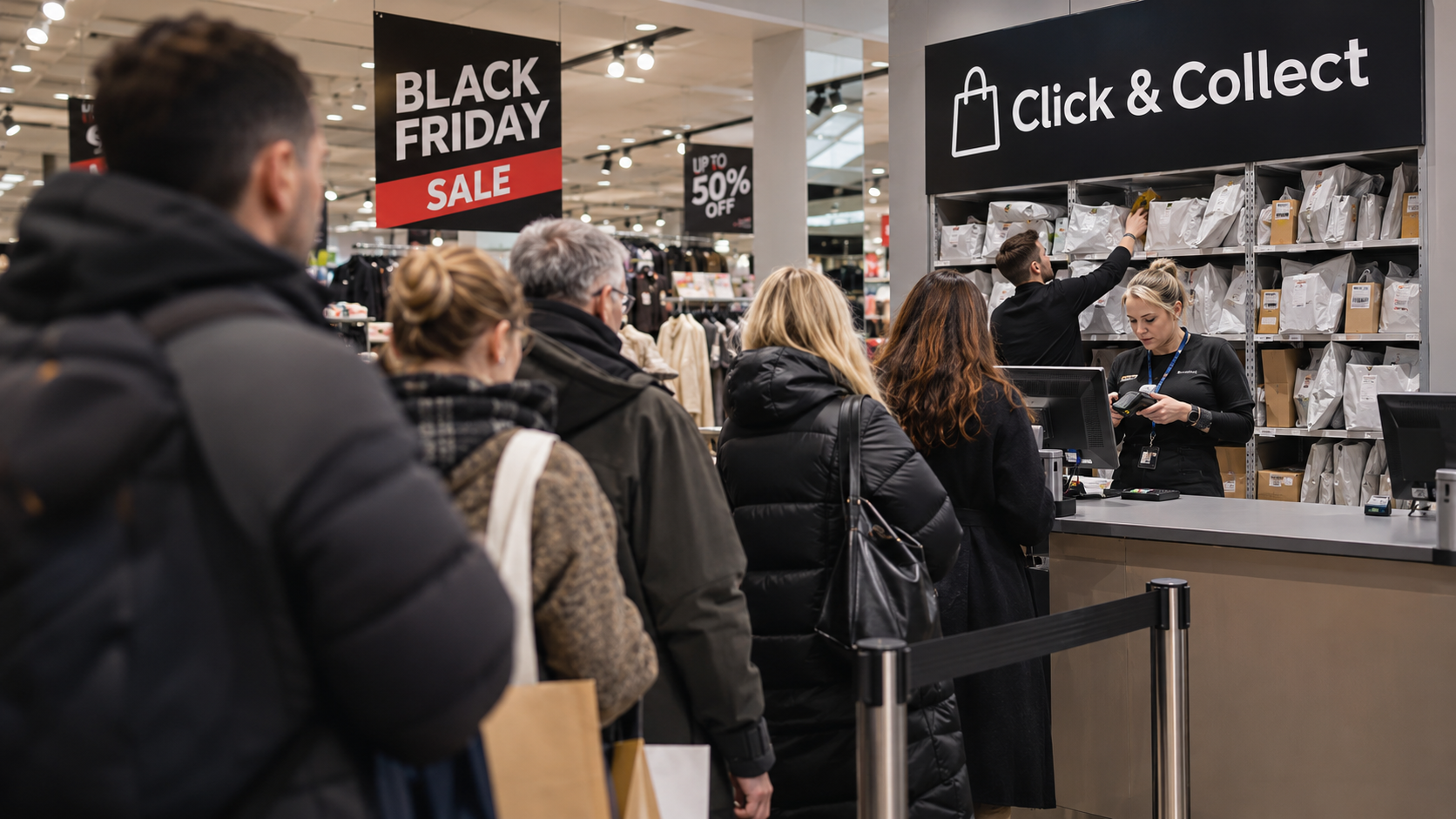
That final handover can involve a surprising amount of manual coordination. Store colleagues must identify the customer, locate the order, retrieve it from storage and complete the collection process, often while balancing other responsibilities. When collection volumes increase during peak trading, these routine activities can create queues, additional labour requirements and unnecessary customer waiting.
The challenge does not end when the promotional period finishes. Black Friday and the wider Christmas trading season are followed by returns activity, placing further demands on store colleagues, inventory management and reverse logistics.
For retailers seeking to improve peak-trading performance, the opportunity is therefore broader than processing more orders. It involves examining how efficiently purchases move through the entire customer journey, from the initial online transaction to collection and, where necessary, return.
Why retailers optimise the click but overlook the collect
Retailers have become increasingly sophisticated at optimising the digital purchasing experience. E-commerce teams routinely analyse conversion rates, basket abandonment, page performance and customer behaviour, while marketing functions use increasingly advanced tools to improve targeting, personalisation and promotional effectiveness.
These investments are supported by significant operational activity behind the scenes. Retailers work to improve stock visibility, fulfilment accuracy and delivery performance so that customers can purchase products with confidence and receive them within the promised timeframe.
However, the physical collection experience often operates within a different organisational structure. Responsibility may be shared between e-commerce, fulfilment, retail operations and individual stores, with each function measuring success against different objectives.
An e-commerce team might consider an order successfully converted when payment is completed. A fulfilment team might regard it as complete when the order reaches the designated collection location. Store operations, meanwhile, remain responsible for ensuring the customer can actually retrieve it.
This division of responsibility can create an operational blind spot.
Traditional Click & Collect processes generally depend on a colleague-mediated handover. The customer arrives at a collection desk, provides their order details and waits while a colleague retrieves the purchase. The process is familiar and can work effectively when volumes are manageable, but its efficiency depends on staffing availability, order organisation and the number of customers arriving within a particular period.
During Black Friday, these dependencies become more significant. Increased order volumes do not necessarily translate into a predictable flow of collection visits. Customers may arrive during lunch breaks, after work or at weekends, creating concentrated periods of demand that do not align neatly with store staffing plans.
A retailer can therefore achieve excellent online conversion and fulfilment performance while still delivering an inconsistent final customer experience.
The issue is not that Click & Collect is inherently inefficient. It is that the physical handover is sometimes treated as a minor administrative activity rather than a distinct operational process requiring its own capacity planning, performance measures and customer experience standards.
The hidden operational cost of peak collection demand
One of the attractions of Click & Collect is that it uses an existing retail network to fulfil online demand. Rather than delivering every order to a customer's home, retailers can consolidate fulfilment activity around stores and other established collection locations.
However, the apparent simplicity of store collection can obscure the cost of completing the final handover.
Every manually managed collection requires some degree of colleague involvement. Depending on the store layout and operating model, this might include checking order details, locating the purchase, travelling to a storage area, retrieving the item and confirming collection.
Individually, these activities may appear relatively inexpensive. Across a large store network, however, the cumulative effect can become substantial.
Consider an illustrative retailer processing 500 collections per store each week. If each handover requires an average of three minutes of colleague time, that represents 25 hours of labour per store before accounting for exceptions, misplaced orders or additional customer enquiries.
For a network of 100 stores, the same process would consume approximately 2,500 colleague hours each week. These figures are hypothetical, but they demonstrate why even modest improvements in handover efficiency can become commercially meaningful when applied at scale.
The impact is not limited to direct labour expenditure. Colleagues occupied with order retrieval are unavailable for other activities, including customer assistance, merchandising and replenishment. Collection queues can interfere with normal store operations, while temporary increases in demand may require additional staffing or overtime.
There is also a customer experience cost. A customer who has deliberately chosen Click & Collect for its convenience may be disappointed if the process involves a lengthy wait or uncertainty about where their order is located.
For retail operations leaders, these considerations suggest that collection performance should be evaluated using more than order volumes and fulfilment completion rates. Average handover time, colleague involvement, customer waiting, exception rates and the overall cost per collection can provide a more complete understanding of operational efficiency.

Black Friday is the most honest test a retailer will ever get of their Click & Collect. If the handover is slowing stores down, peak will show it quickly. A small pilot lets retailers try a smoother collection journey in a few stores, see what the data tells them and fine-tune it before they scale anything.
Preparing collection operations for peak demand
Effective peak preparation requires retailers to understand not only how many orders they expect to process, but also when, where and how customers will collect them.
This distinction matters because collection demand is not necessarily distributed evenly across a store's opening hours. Order volumes may be forecast accurately at a network level while individual locations experience significant variation in customer arrival patterns, available storage capacity and colleague workload.
A useful starting point is to examine historical collection activity alongside broader store performance. Retailers should understand which locations experience the greatest demand, how long orders remain awaiting collection and whether existing processes can accommodate short periods of unusually high activity.
The operational review should consider four connected areas:
| Planning consideration | Questions retailers should address |
| Collection capacity | Can stores accommodate expected order volumes and peak customer arrival periods? |
| Labour requirements | How much colleague time is consumed by each collection, and how does this affect other responsibilities? |
| Customer experience | How long do customers wait, and what happens when orders cannot be located or collected? |
| Operational visibility | Can the retailer measure collection performance and identify problems across its store network? |
These questions help distinguish between short-term peak preparations and more fundamental improvements to the operating model.
Adding temporary colleagues may provide additional capacity, but it does not necessarily resolve an inefficient handover process. Similarly, expanding collection storage can reduce congestion without addressing the time required to retrieve individual orders.
Retailers should therefore examine whether their existing collection arrangements remain appropriate for the volumes they expect to handle, particularly where Click & Collect has grown considerably since the original process was introduced.
How collection automation can improve operational efficiency
One approach to improving collection performance is to reduce the amount of manual coordination required at the point of handover.
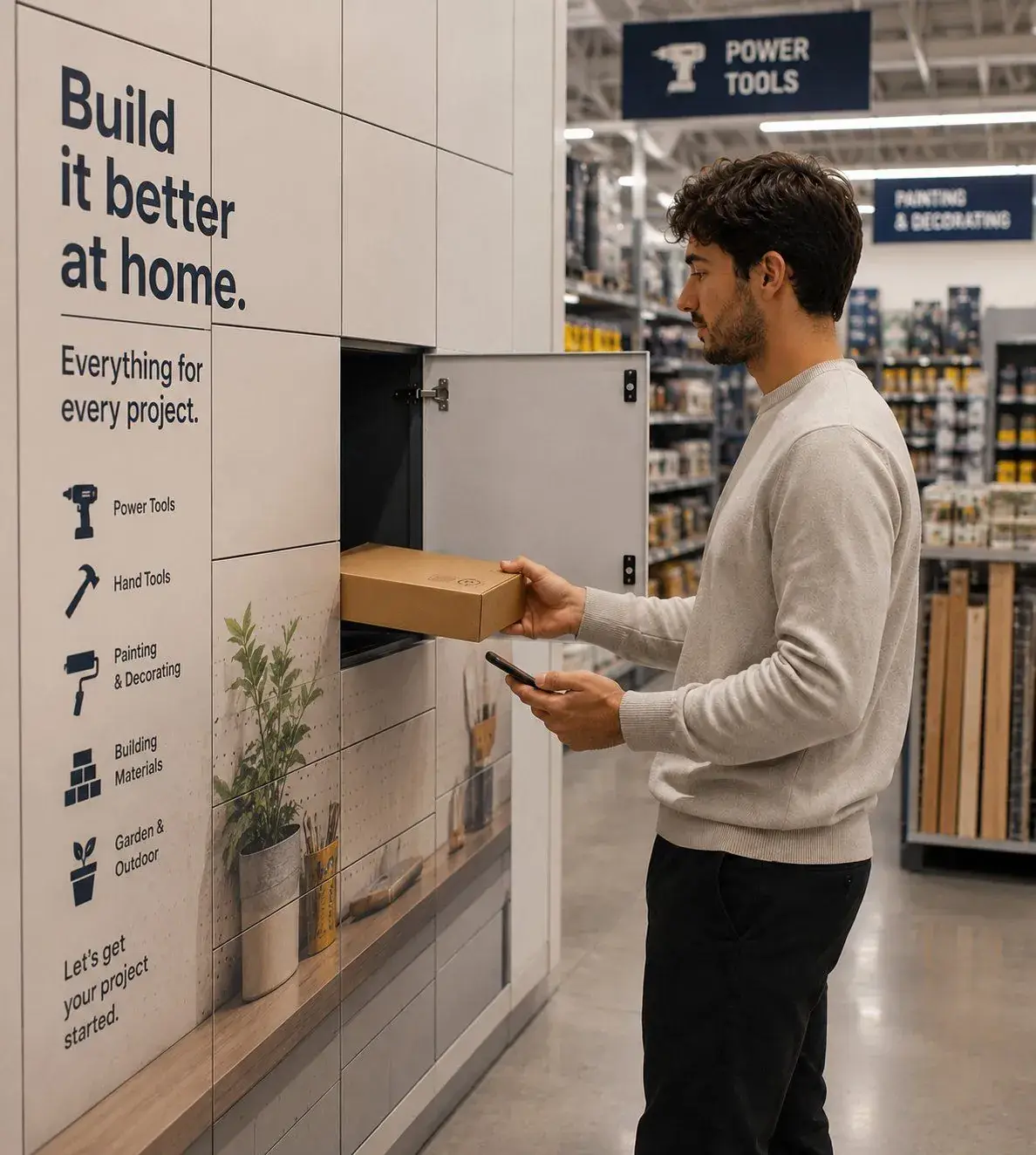
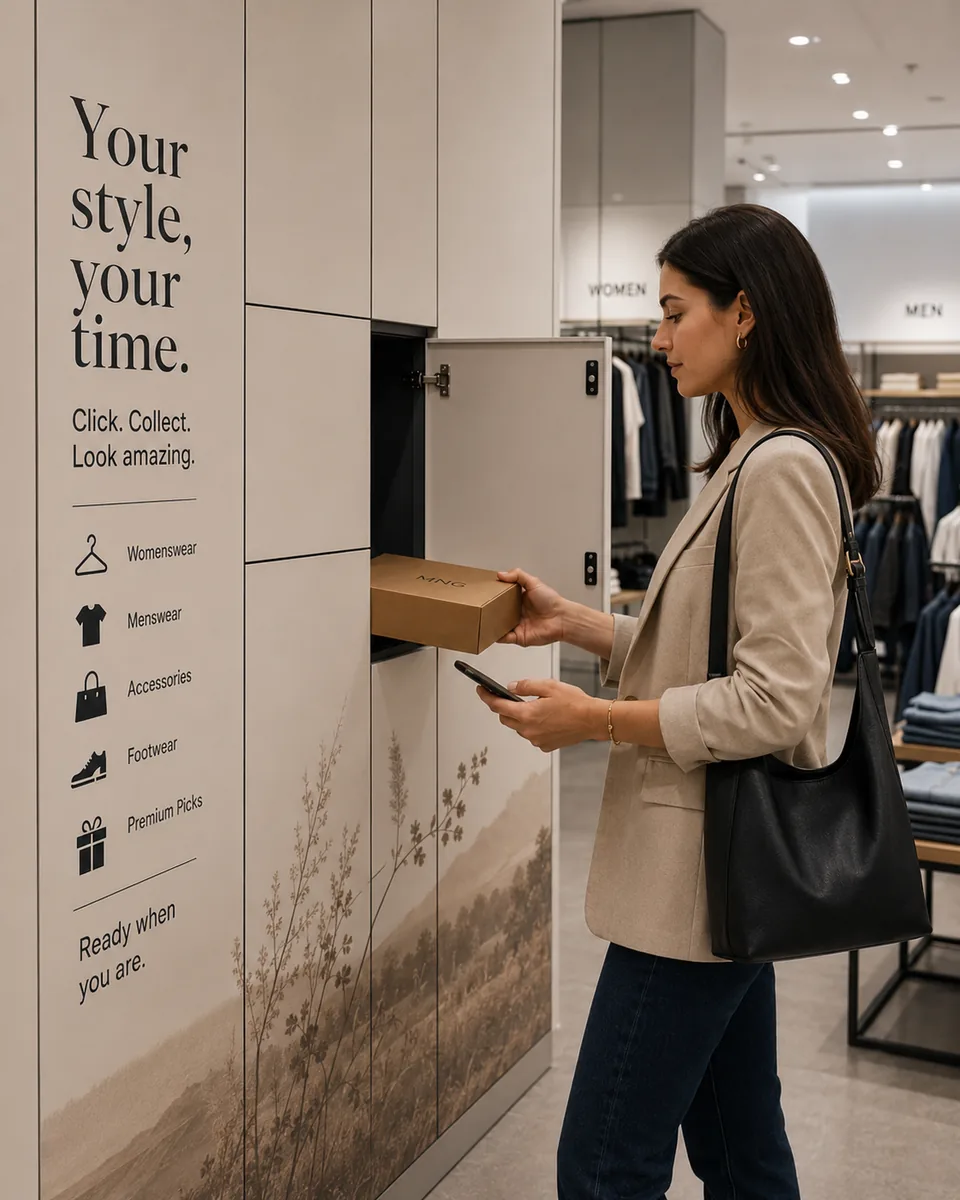
Automated collection systems, including smart lockers, allow retailers to separate the preparation of an order from the customer's arrival. Once an order has been picked and made ready for collection, it can be placed in a designated compartment and made available through a digitally controlled access process.
Depending on the system configuration, the customer can receive a notification containing collection instructions and authenticate themselves when they arrive. The appropriate compartment is then released, allowing the customer to retrieve their purchase without requiring a colleague to manage every routine handover.
The underlying benefit is not simply that a locker replaces a collection desk. It is that the physical transfer becomes part of a more structured workflow, connecting order readiness, customer communication, access control and transaction recording.
For retailers, this can create several operational advantages:
- Colleague involvement can be concentrated around preparing and depositing orders rather than managing each customer's arrival.
- Customers may be able to collect purchases independently, reducing their reliance on the availability of a service-desk colleague.
- The resulting transaction records can provide better visibility of collection activity and how capacity is being used.
These advantages are particularly relevant during periods of concentrated demand, when manual collection processes can become constrained by the number of colleagues available to complete handovers.
Where lockers are installed outside the store, collection is no longer tied to opening hours. Customers can collect at any time of day or night, so evening and weekend arrivals don’t depend on a colleague being on shift. During Black Friday this is often the biggest single gain, because the busiest collection times rarely line up with the hours stores are best staffed.
However, successful automation depends on more than installing physical equipment. Retailers must consider compartment capacity, order sizes, store layout, customer accessibility, communication processes and how the system interacts with existing fulfilment operations.
The technology also needs appropriate exception handling. Oversized orders, collection problems, uncollected purchases and customers requiring assistance still need a defined operational response.
The strongest implementations therefore begin with an understanding of the existing process and the specific inefficiencies the retailer wants to address. Automation should be evaluated against measurable improvements in collection efficiency, customer convenience and operating cost, rather than treated as an objective in its own right.

The retailers who get the most from automation sort out the basics first. Orders have to be ready when the customer is told they are, and each store needs a process to own the exceptions, like oversized items and orders nobody collects. With that in place, lockers can take most routine collections off the desk during peak. Skip that step and the queue just moves from the desk to the locker.
Turning Click & Collect into a commercial opportunity
The business case for improving Click & Collect extends beyond operational efficiency.
One of the distinguishing features of store-based collection is that it brings online customers into a physical retail environment. Unlike home delivery, where the fulfilment interaction takes place away from the store, Click & Collect creates an opportunity for customers to engage with the retailer's wider product range.
For retailers with an established store network, this represents a potentially valuable connection between digital demand and physical retail activity.
A customer collecting an online purchase may browse additional products, purchase complementary items or return to the store for a subsequent transaction. In categories where customers value advice, product availability or immediate access to related items, the commercial opportunity may be particularly relevant.
This additional purchasing activity is often described as halo spend: revenue generated beyond the original order as a consequence of the customer's interaction with the store.
However, the relationship between collection convenience and incremental revenue requires careful consideration.
A faster collection process does not automatically guarantee that customers will spend more money. Some customers choose Click & Collect specifically because they want to complete the transaction quickly and leave. Others may welcome the opportunity to browse or purchase additional products.
The more useful commercial question is whether improving collection convenience makes the channel more attractive, increases repeat usage and creates additional opportunities for profitable store visits.
Retailers can begin to evaluate this by examining the relationship between collection transactions, subsequent in-store purchases and customer behaviour over time. Where customer and transaction data can be connected appropriately, it may be possible to identify whether collection visits generate incremental spending beyond what would otherwise have occurred.
This requires more than counting customers entering the store. Retailers should distinguish between additional revenue genuinely associated with collection activity and purchases that customers would have made regardless.
There is also an important customer experience consideration. A retailer should not deliberately make collection slower or more complicated to increase browsing time. The objective should be to create a convenient collection journey while making relevant additional purchases easy for customers who want them.
For omnichannel leaders, this changes the commercial framing of collection optimisation. Rather than viewing Click & Collect exclusively as a fulfilment cost, it becomes part of a wider strategy connecting customer convenience, store utilisation and potential revenue growth.
After Black Friday: Why returns deserve equal attention
While the build-up to Black Friday is dominated by promotional activity and order fulfilment, the period that follows creates a different operational challenge.
Customers begin returning unwanted, unsuitable or duplicate purchases. Some returns relate directly to Black Friday promotions, while others emerge later as Christmas gifts are exchanged or refunded.
For retailers, this creates additional activity across customer service, store operations, inventory management and reverse logistics.
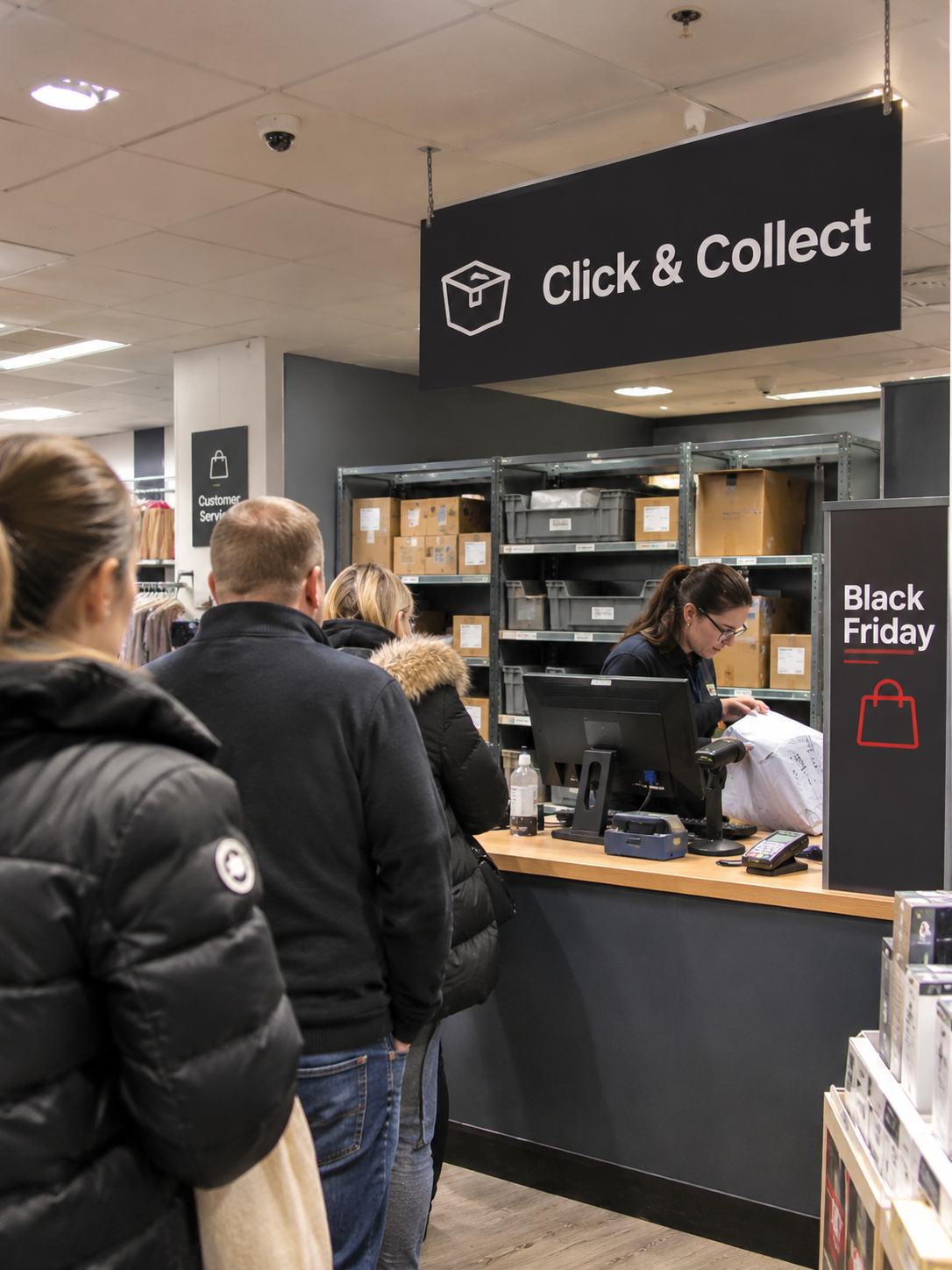
The returns process is often more complicated than the original collection. A customer may need to present an order reference, explain the reason for the return and wait while a colleague checks the item or initiates the appropriate transaction.
The product must then be handled according to its condition and the retailer's returns policy. Depending on the item, this may involve inspection, repackaging, restocking, transfer to another location or further processing before it can become available for resale.
These requirements mean that returns cannot always be automated in the same way as collections. The physical handover is only one part of a broader operational process.
Nevertheless, the point at which a customer returns an item can create many of the same inefficiencies associated with traditional Click & Collect.
Customers may need to queue at service desks, colleagues must manage repetitive handovers, and stores need sufficient capacity to hold returned goods before they are processed.
Where the returns workflow permits it, self-service systems can reduce some of this manual coordination.
For example, a customer may be able to initiate a return through an approved digital process and deposit the item into a designated smart locker compartment. The system can record the deposit transaction and make the item available for subsequent handling by the retailer.
This does not mean the return has necessarily been inspected, accepted for refund or restored to inventory. Those activities remain subject to the retailer's policies and operational controls.
The opportunity is to make the physical return more convenient while creating a clearer record of when the item was deposited and what needs to happen next.
The returns rush after Black Friday is predictable, which makes it a great moment to test a better way of handling it. With a pilot, retailers can trial self-service returns in a handful of stores, measure what actually changes and get the proposition right before rolling it out for next peak.
Using peak-trading data to identify operational weaknesses
Black Friday provides retailers with an unusually demanding test of their operating model.
Processes that perform adequately during normal trading can become less reliable when order volumes increase, customer arrivals become concentrated and colleagues are required to manage competing priorities.
This makes peak trading a valuable opportunity to understand where operational capacity is genuinely constrained. However, the usefulness of that information depends on whether the retailer can measure the relevant activities.
Traditional collection processes may provide good visibility of order fulfilment status without capturing the full customer handover. A system might record when an order becomes ready for collection and when it is marked as collected, but offer limited insight into how long the customer waited, how much colleague time was involved or why a particular transaction required intervention.
More structured digital collection workflows can provide additional operational information, although the exact data available depends on the system and its integration with the retailer's wider technology environment.
For example, transaction records may help retailers understand collection volumes, the time between order readiness and collection, compartment utilisation and the frequency of certain operational exceptions.
These measures can support more informed decisions about store capacity, staffing and process design.
| Performance measure | Potential operational insight |
| Collection volume by location and time | Where and when demand is concentrated |
| Time from order readiness to collection | How long orders occupy collection capacity |
| Collection transaction duration | How efficiently the physical handover is completed |
| Compartment utilisation | Whether automated collection capacity is appropriately sized |
| Uncollected orders and exceptions | Where intervention or process improvement may be required |
| Returns volume and processing time | How effectively the reverse logistics process responds to demand |
Not every measure will be available automatically, and a recorded locker transaction does not necessarily reveal the complete customer experience. Retailers may need to combine system data with customer feedback, operational observations and other business information.
The important principle is that collection and returns performance should be evaluated with the same discipline applied to other parts of the omnichannel journey.
Rather than relying on anecdotal reports that stores were busy or colleagues struggled during peak, retailers can use operational evidence to identify where delays occurred, what caused them and which improvements are likely to create the greatest value.
Turning post-peak lessons into better investment decisions
Once peak trading has ended, retailers face an important decision about how to respond to the operational pressures they experienced. The immediate temptation may be to focus on the most visible problems: increasing staffing, expanding storage capacity or introducing temporary arrangements to manage demand.
These measures may be appropriate, particularly where demand spikes are short-lived. However, they should be considered alongside the possibility that the underlying collection or returns process is no longer suitable for the scale of the operation.
For example, a retailer that repeatedly requires additional colleagues to manage collection queues may be experiencing a structural limitation in its handover process rather than a temporary staffing shortage.
Similarly, stores that struggle to accommodate growing volumes of orders awaiting collection may need to reconsider how space is allocated, how quickly customers are notified and how collection capacity is managed.
The post-peak review should therefore examine the causes of operational friction rather than simply record its symptoms.
This is particularly important when evaluating automation investments. A business case for smart lockers should not depend exclusively on the purchase price of the equipment or an assumed reduction in labour.
It should consider the wider economics of the existing process, including colleague time, collection throughput, customer convenience, exception management and the potential for additional store activity.
The same assessment should also account for implementation costs, software requirements, integration, maintenance and any changes needed to support the revised workflow.
For retailers operating multiple stores, a measured pilot can provide a useful starting point. Comparing collection performance before and after a change, while accounting for differences in demand and store conditions, can help establish whether the investment delivers sufficient operational and commercial value to justify expansion.
Importantly, the lessons from Black Friday should inform decisions well before the next peak season. Improvements to collection infrastructure, store workflows and technology integration require planning, testing and operational adoption.
Waiting until the next promotional period approaches may leave insufficient time to address the underlying problem.
Every store manager will tell you peak was busy. That’s not much use when you’re setting next year’s budget. What helps is knowing which stores had orders piling up, where collections took longest and whether the extra hours you paid for actually cleared the backlog. Those answers show whether you’ve got a short-term crunch or a process that needs changing, and that’s where any investment should start.
Rethinking peak performance across the entire customer journey
Black Friday is often judged by the most visible commercial indicators: sales revenue, online conversion, order volumes and fulfilment performance. These remain essential measures, but they do not provide a complete picture of how efficiently a retailer has served its customers.
For omnichannel retailers, the physical collection and returns experience represents an important connection between digital commerce and store operations. When that connection depends on repetitive manual processes, increased demand can expose weaknesses in labour efficiency, customer convenience and operational visibility.
Improving these processes requires a broader view of retail performance.
Retailers need to understand how collection demand affects stores, whether existing handover arrangements can scale, how returns are managed and what the resulting operational data reveals about future capacity requirements.
Automation can form part of the response, particularly where routine transactions can be completed through a controlled self-service process. However, the greatest value comes from redesigning the workflow around the needs of customers and the wider operation, rather than simply introducing new technology.
There is also a wider commercial opportunity. A convenient collection experience can strengthen the appeal of Click & Collect, support productive store visits and create opportunities for additional customer spending. Realising that value requires retailers to measure outcomes and understand how collection activity contributes to the overall economics of their omnichannel model.
As retailers prepare for Black Friday and review performance afterwards, the question should therefore extend beyond how successfully they attract and fulfil online demand.
It should also consider how effectively they complete the customer handover, manage the return journey and use what they learn to improve the next trading cycle.
Explore smarter retail collections and returns
eLocker helps retailers explore how automated collection and return workflows can reduce manual handover friction, improve operational visibility and support a more convenient customer experience.
Discover eLocker’s Retail Click & Collect and Retail Returns solutions or speak with the team about how collection automation could fit into your retail operating model.